
Thursday, 11 June marked the beginning of the 2026 FIFA World Cup. The World Cup is the most-watched sporting event in the world, and this year’s edition is the biggest of all time, with 48 countries competing.
As billions of football fans (or soccer fans, depending on where you are) tune in to see their teams compete on the world stage, many will rely on the Internet to watch matches and keep up with the latest news.
When two teams face off, their fans might all be watching the same match. But depending on where they are in the world, their experience viewing the game online and using the Internet to follow the match may be vastly different.
This is, in large part, due to differences in Internet resilience.
What Is Internet Resilience?
Just like a resilient team in the World Cup, a resilient Internet can perform well despite challenges—like infrastructure damage, cyberattacks, and high traffic.
We’ve gathered data from Internet Society Pulse, which assigns a resilience score to each country, out of 100. Just like there are several factors that make a great football team—offense, defense, communication, strategy—there are several factors that play into a country’s overall resilience score.
This score considers four areas that are central to a resilient Internet:
- Infrastructure: Physical infrastructure for Internet connectivity exists and is available.
- Market readiness: The market can offer affordable prices to consumers by maintaining diversity and competition.
- Performance: Consumers have seamless and reliable Internet services.
- Security: Technologies and best practices support a network’s ability to resist disruptions.
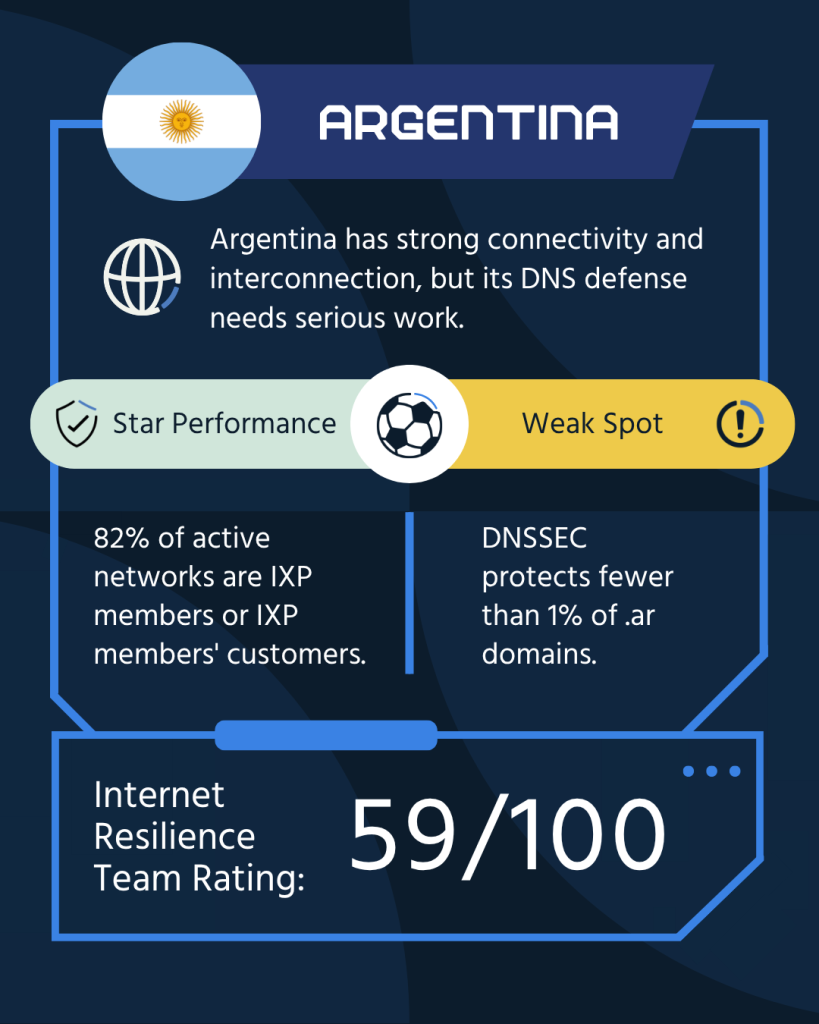
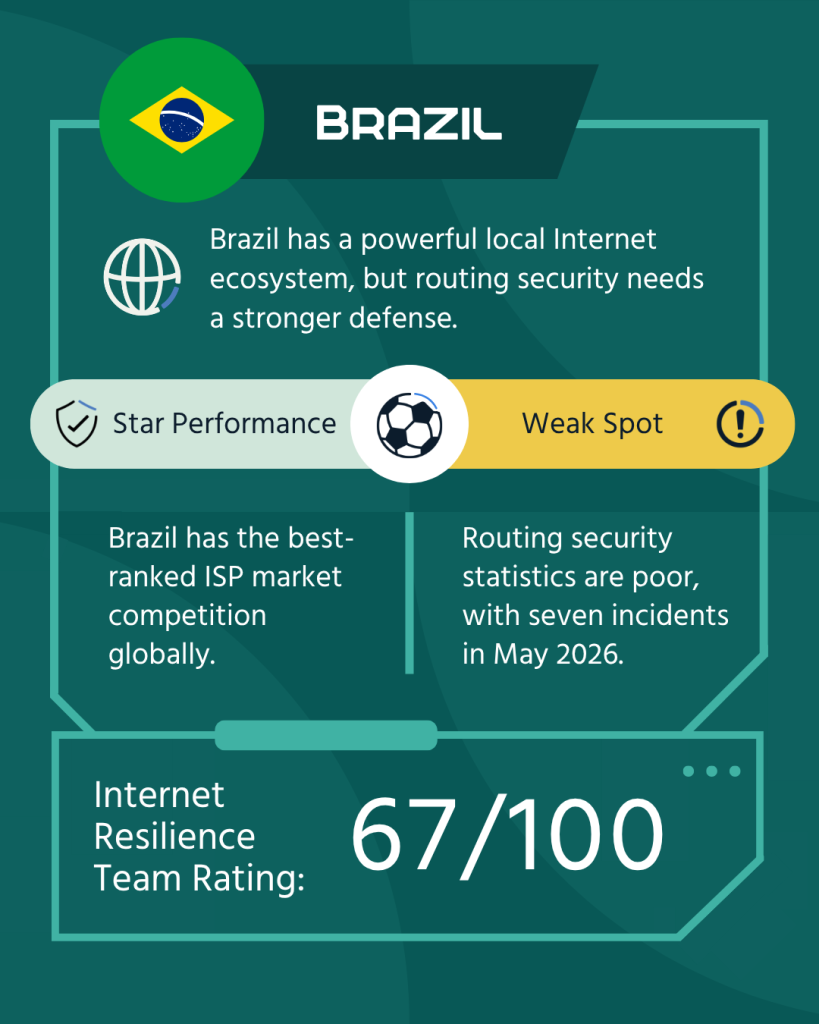
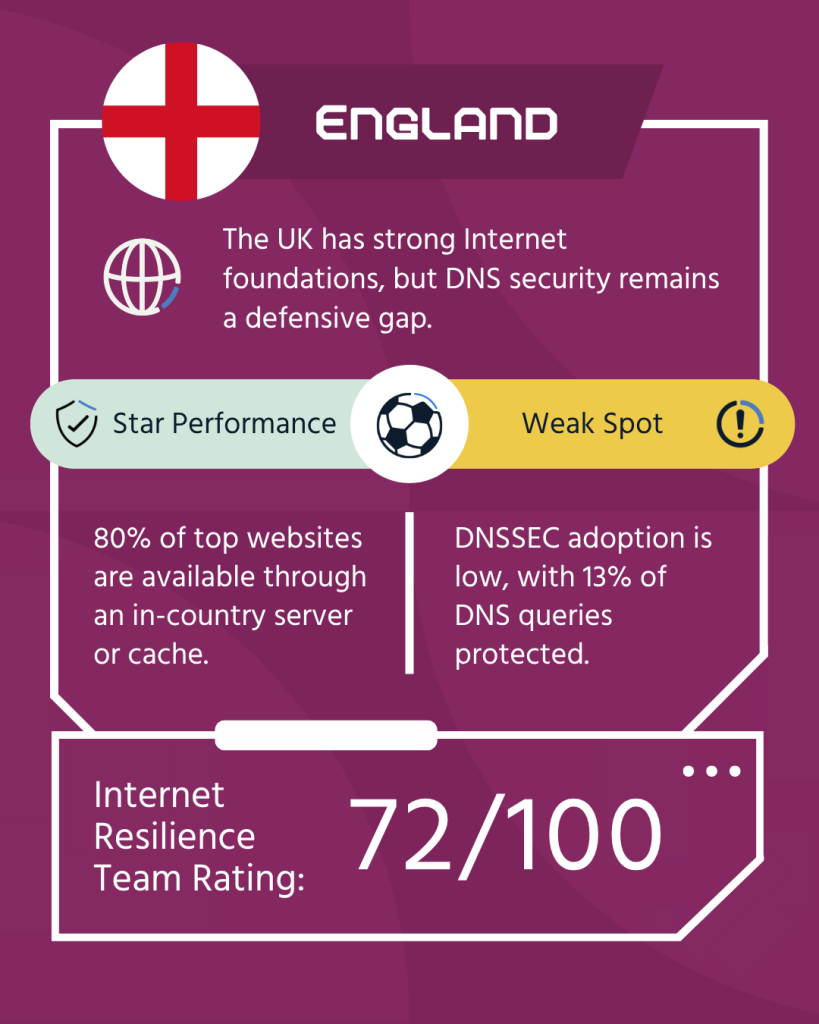
So, while the best football team will win the FIFA World Cup, how does your country compare in the World Cup of Internet resilience? We took a look at the top- and bottom-seeded World Cup contenders, according to the FIFA ranking, and analyzed their strengths, weaknesses, and overall resilience scores.
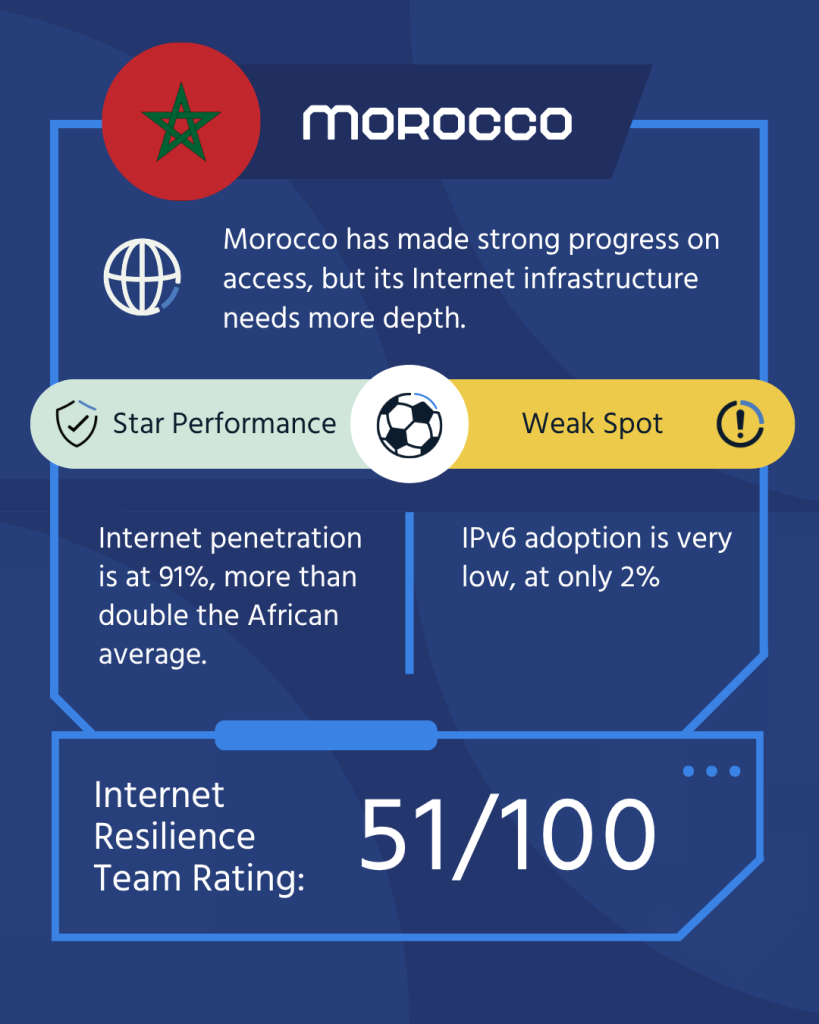
Considering Strengths and Weaknesses
When we assess the factors that contribute to Internet resilience, there are several specific indicators we may consider. Depending on how widely or effectively countries implement them, these indicators can help us identify strengths and weaknesses in a country’s Internet.
Internet exchange points (IXPs) allow communities to exchange Internet traffic locally, a process called peering. Because traffic doesn’t have to travel internationally, service is typically faster and more affordable. If a disruption happens (e.g., a subsea cable breaks), a community can still access locally cached content.
Domain Name System Security Extensions (DNSSEC) add an additional level of security to the Domain Name System. This system underpins the basic functions of the Internet by translating human-readable language into machine-readable language.
Internet penetration refers to how widespread Internet use is. We measure this as the percentage of a population that has used the Internet in the last three months.
IPv6 adoption is crucial for supporting the massive scale of the modern Internet. IPv6 is the most recent version of the Internet protocol, a fundamental technology that enables data to move across the Internet. Many networks still use the previous version, IPv4, which can only support a much smaller number of connected devices.
This is not, by any means, a comprehensive list of resilience indicators. But considering them can give us a better sense of the Internet landscape in a country, and areas where local governments, technical groups, and communities can make changes for a better, more resilient Internet.
At the end of the day, just like in the World Cup, no team is perfect, and even the strongest teams have areas in which they can improve.
Do you want to learn more about Internet resilience in your country? Check out the full country report on Internet Society Pulse.
Image © Sinseeho on Adobe Stock