
When we launched the Safer Internet Initiative earlier this year, our message was clear: connectivity is essential, but it is not enough. Everyone needs to feel safe, protected, and empowered when they go online.
Six months later, that work has moved from vision to action. Across the Internet Society and Internet Society Foundation, we are advancing a connected set of efforts to strengthen online safety and security for people and communities worldwide.
Through community mobilization, targeted funding, practical training, trusted resources, and advocacy, the Safer Internet Initiative is helping address the risks people face online—from scams, fraud, and harassment to privacy violations, misinformation, cyberattacks, and attacks on encryption.
This work is especially important for people who are newly connected or have limited access to online safety resources. Without the right knowledge, tools, and support, online risks can prevent people from fully benefiting from the Internet for education, work, banking, healthcare, public services, and connection with family and community.
That is why we are advancing the Safer Internet Initiative across several areas.
Funding Cybersecurity for the Public Good
In June, the Internet Society Foundation opened the first global call for applications to the Common Good Cyber Fund (CGCF), a multi-year funding initiative supporting nonprofit organizations that protect civil society and strengthen the Internet’s core cybersecurity infrastructure.
The application window closed on 4 August 2026, and submissions are now under review. Through this call, the fund expects to award at least USD $3.5 million in two-year grants. This marks the next phase of the initiative following its 2025 launch and pilot phase, which awarded six initial grants to address urgent gaps in the global cybersecurity ecosystem.
The CGCF supports nonprofit organizations that maintain critical cybersecurity infrastructure, deliver scalable support to protect Internet users from digital harm, and advance a safer Internet for high-risk communities, including civil society and journalists. The fund is supported through pooled contributions from a diverse group of donors, including the governments of Australia, Canada, Germany, the Netherlands, and the United Kingdom, as well as Craig Newmark Philanthropies and the Internet Society.
Helping People Recognize and Prevent Scams
Online scams have become one of the fastest-growing threats facing Internet users. Helping people recognize and avoid online scams takes more than awareness campaigns; it calls for practical skills, trusted resources, and local support.
Through funding from Google.org, we are designing and implementing a comprehensive set of resources to help people identify, avoid, and respond to online scams. This work includes an awareness and prevention toolkit, a global training curriculum, an e-learning course, and a train-the-trainers model that enables local partners to deliver the materials in culturally and linguistically relevant ways.
The initiative will build resources for a global audience of users and community leaders, including law enforcement agencies, older adults, youth, young professionals, and local associations. We will grow this work through a targeted program that will support local organizations in adapting and implementing the anti-scam resources in ways that respond to their communities’ needs.
Building the Online Trust and Safety Hub
In parallel with the anti-scam work, we are also preparing to launch the Online Trust and Safety Hub in September. The hub will be a trusted starting point for people seeking clear, practical advice on staying safe online. In addition to the previously mentioned anti-scam resources, it will bring together resources on spotting false information online and protecting your privacy and security.
Just as important, we are not building the hub for our community. We are building it with our community. Our first step is a consultation process with Internet Society chapters, members, and partners who are reviewing an early version of the hub and providing feedback. Their input will help ensure the hub is accessible, culturally relevant, practical, and useful in low-bandwidth environments and across languages and contexts.
Supporting Community-Led Action
The Internet Society’s greatest strength is its global community. Lasting improvements to online safety cannot be delivered through global campaigns and initiatives alone—they depend on trusted local organizations that understand their communities and can adapt resources to local realities.
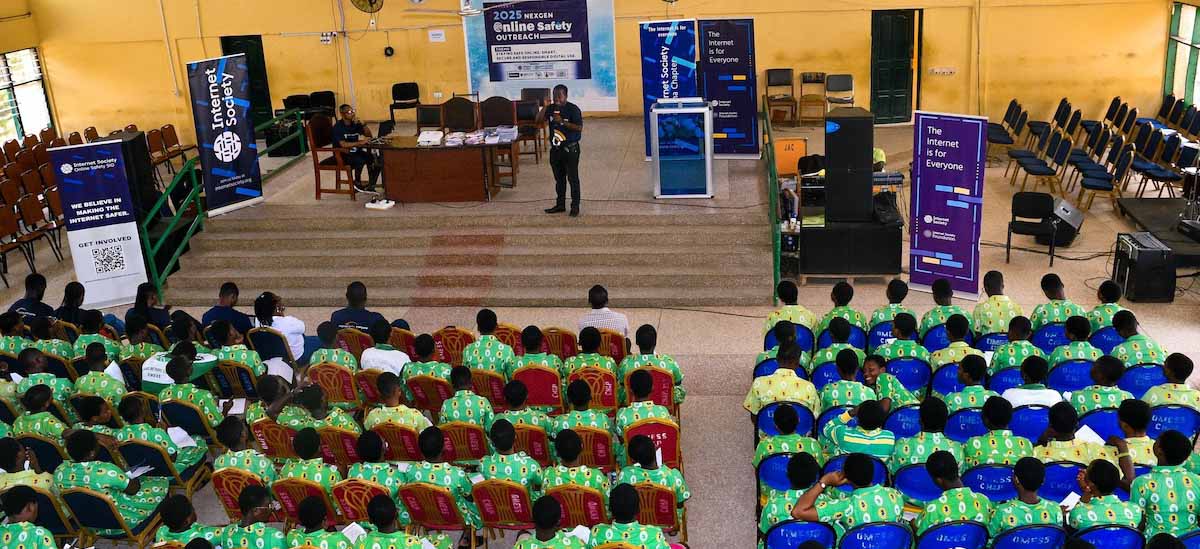
Over the past year, several Internet Society chapter-led projects supported through the Internet Society Foundation’s Beyond the Net grant program have helped communities build practical online safety knowledge and skills. The Ghana Chapter organized a NexGen Online Safety Outreach Project. The Lesotho Chapter led a cybersecurity hackathon. The Hong Kong Chapter delivered a CyberSafe for All training. Our Mexico chapter organized a series of short courses to help older adults build knowledge, skills, and confidence. The Zimbabwe Chapter worked to enhance cybersecurity for self-employed women.
These are only a few examples. Other relevant projects are also underway, reflecting the strength of our community-led model: local people, responding to local needs, with practical tools that help communities protect themselves and others online.
Advocating for Safety, Security, and Privacy
Creating a safer Internet requires more than funding, training, and trusted resources. It also depends on the decisions made by governments, regulators, technology companies, and standards bodies that shape how people experience the Internet every day.
That is why the Safer Internet Initiative combines practical action with advocacy. We advance policies that strengthen online safety while protecting the privacy, security, and openness that underpin a trustworthy Internet. We reject the false choice that people must give up privacy or accept weaker security in order to be safer online. Strong encryption, secure communications, and privacy are not obstacles to safety—they are essential foundations of it.
This approach is reflected in our recently published policy brief, Solving Crime Without Breaking Encryption, which demonstrates that governments can support effective law enforcement without weakening the encryption that protects billions of people every day.
In the months ahead, we will continue advancing evidence-based policy recommendations on online trust and safety, including promoting technologies such as virtual private networks (VPNs) that help people access the Internet securely, and advocating for policies that strengthen safety, security, and privacy by design.
The Internet is a powerful resource for opportunity, connection, and resilience. But people can only benefit from it fully when they can use it safely and with confidence.
The Safer Internet Initiative is how we are helping make that possible. Learn more here.
Image © Internet Society Ghana Chapter