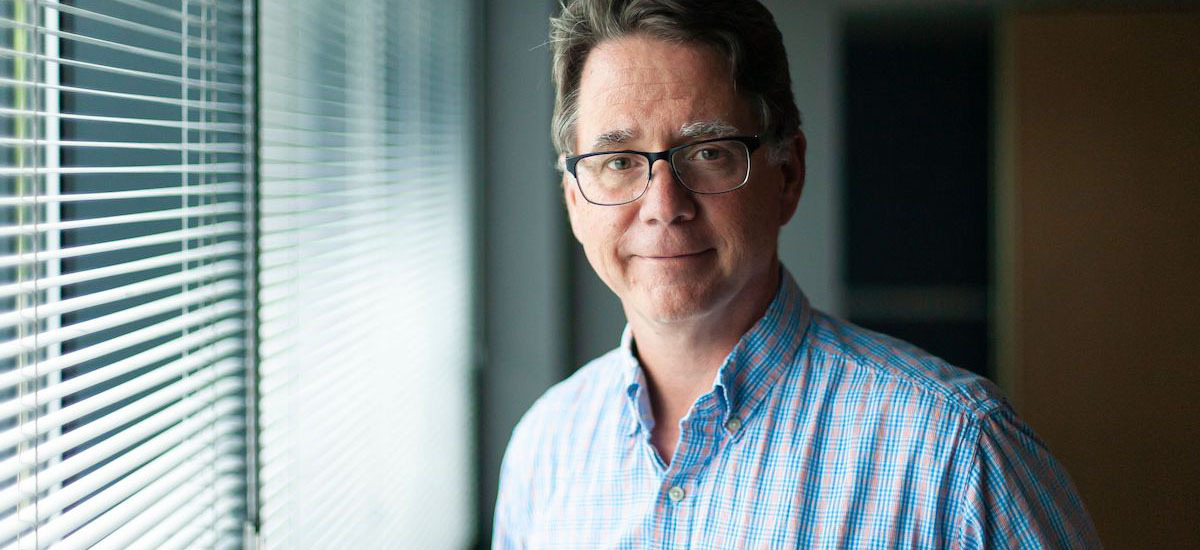

Ted Hardie, chair of our Board of Trustees, spoke to Internet Society and Foundation staff on 14 May 2026. He served on the board from 2007 to 2009 and rejoined in 2020. After many years of excellent service, Ted’s time on the board will conclude on 25 July 2026.
One of the roles of the Internet Society Board of Trustees is also to be the board for the Internet Society Foundation. And the Internet Society Foundation mission actually reads, “The Internet Society Foundation champions ideas and enables communities to unlock the Internet’s potential to tackle the world’s evolving challenges.”
And the reaction of the board when we were asked to approve this was, “exactly right.” You don’t talk about the giving, you don’t talk about how, you talk about what the goal is: to enable the Internet’s potential—to enable communities to use the Internet’s potential to tackle the challenges that they face.
Now, I wanted to kind of go through these different pieces of history and mission, partly because they show how long and how thoroughly people are at the core of what we do.
I also want to because we’re facing really challenging times, very different from any other era of the Internet’s history.
Dark patterns of engagement have been used both to trap end users in walled gardens and to use their time in those gardens in a way that fundamentally works to separate them from each other rather than to connect them or [allow] them to build open communities.
That micro-targeting has enabled propaganda, and it’s resulted in basic denial of the reality of the world we live in.
The usage of those patterns across the Internet has caused many governments to look at preventing some users from accessing the Internet.
The most prominent set at the moment is age verification, to try and keep young people away from social media. But once those tools are in place, they will find other targets.
Age verification itself involves revealing key personal information or biometrics, and that loss of privacy has exactly the same harm as pervasive surveillance. It causes self-censorship or a loss of access entirely.
To repeat what I said at IETF 88, at the scale of the modern Internet, that harms humanity.
There are also, unfortunately, governments who have allied with the purveyors of these dark patterns to increase their control not just of the actions of their citizens, but their very thoughts—a kind of authoritarian discipline that we’d all hoped would remain in the pages of dystopian fiction.
And so we have to kind of ask ourselves, in light of how people are using that Internet, should we change the mission? And I think the answer is no.
We need to change how we act on the mission, but each of the statements I quoted before remains true. We have to focus our efforts on the users, and most especially on the most vulnerable users and communities.
Most of the time, that will be using our usual tools: advocacy, funding, analysis, building coalitions both within our communities and with our sister organizations, both in the technical and civil society communities.
But it will sometimes go beyond that. We will need to use our time and treasure to oppose those dark patterns more vehemently and more forcefully than ever before.
And we need to do this not to try to get back to an Internet before social media or the web, this isn’t a rear-guard action, but to move forward to an Internet where those serve the user rather than exploit them.
It’s been maddening at times to listen to the age verification debate, where people describe the harm of these dark patterns and end up deciding not to tackle the dark patterns and improve things for everyone, but just to limit the people who can be harmed.
And I think we have to recognize that the Internet will change, but we have to guide that change to continue to keep the user at its core.
And I think we need to do this because we understand that for every dark pattern, there is a true benefit to balance it and go beyond it.
The Internet remains one of the great achievements of technology. It enables communication at a scale humanity has never achieved before. And from that, we have derived opportunities and communities that stretch across borders and societies in a way that still takes my breath away.
Though it is beset at the moment with dark patterns and dark intentions, at its core, it is a light in the world, showing each of us the humanity of the stranger and the opportunity to unite.
It’s our job to ensure that while we are its steward, that light does not go out, and the Internet remains what it should be: for everyone.
It had been an honor to be part of that mission over the past six years, and I hope you understand how much I appreciate the work you and your colleagues do. It’s important, and I trust that despite the current dangers, it will succeed. Thank you.
Image © Irene van Kessel