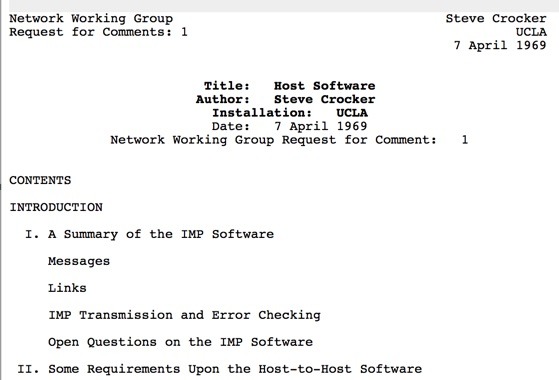

By way of a tweet from @IETF this morning, it was fun to note that it was 46 years ago today, on April 7, 1969, when the very first “Request for Comments” or “RFC” was issued by Steve Crocker. RFC 1 defined the “IMP software” used in the communication between hosts on the ARPAnet and makes for interesting reading today. Steve was in those days a graduate student at UCLA and 46 years later now serves as the Chairman of the Board of ICANN. Back in 1999, Steve offered some reflections in RFC 2555 on 30 years (at that time) of RFCs that included this bit about how it began:
I have already suggested that the early RFCs and the associated Network Working Group laid the foundation for the Internet Engineering Task Force. Two all-important aspects of the early work deserve mention, although they’re completely evident to anyone who participates in the process today. First, the technical direction we chose from the beginning was an open architecture based on multiple layers of protocol. We were frankly too scared to imagine that we could define an all-inclusive set of protocols that would serve indefinitely. We envisioned a continual process of evolution and addition, and obviously this is what’s happened.
The RFCs themselves also represented a certain sense of fear. After several months of meetings, we felt obliged to write down our thoughts. We parceled out the work and wrote the initial batch of memos. In addition to participating in the technical design, I took on the administrative function of setting up a simple scheme for numbering and distributing the notes. Mindful that our group was informal, junior and unchartered, I wanted to emphasize these notes were the beginning of a dialog and not an assertion of control.
Today these RFCs have become the critical open standards that drive the development of the open Internet. The process is much more formal, of course, with the RFC Editor formally charged with overseeing the publishing of the RFCs. There have been many more, too, with RFC 7538 just being the latest one published (the list of most recent RFCs is always available).
Congratulations to the IETF and broader technical community on 46 years of RFCs! I look forward to continuing to see the evolution of the RFCs over the next 46 years.
P.S. More information about Steve Crocker and the first RFCs can be found in links and videos on his Internet Hall of Fame profile.