
Today, 21 May, marks the 15th Global Accessibility Awareness Day (GAAD)—a day dedicated to getting everyone talking, thinking, and learning about digital access and inclusion for people with disabilities.
At the Internet Society, this day resonates deeply, because our vision—”the Internet is for everyone”—can only become reality when we actively work to remove the barriers that prevent people with disabilities from fully participating online.
And there is still a great deal of work to do.
The Scale of the Challenge
According to the GAAD Foundation, more than one billion people worldwide live with a disability. For many of them, the Internet represents a critical pathway to education, employment, healthcare, social connection, and civic participation. Yet a WebAIM analysis of one million home pages in 2020 found that 98.1% had at least one accessibility failure under Web Content Accessibility Guidelines (WCAG) 2.0 standards.
Five years later, the analysis shows a slight decrease to 95.9%, but that is still far too many. And the most common failures—low contrast text, missing image descriptions, unlabeled form fields—are not technically complex to fix. They persist because accessibility is still too often treated as an afterthought rather than a core requirement of how we build sites and services on the Internet.
This has to change. When we design websites and services without accessibility in mind—whether they are web sites, apps, messaging systems, or new AI models—we aren’t just excluding individuals, we are depriving our global society of the perspectives, talents, and innovations that people with disabilities bring. As I’ve said many times: we need everyone engaged if we are to address the complex problems facing our world.
Nothing About Us Without Us
There is a principle that has guided disability rights movements for decades: “Nothing about us without us.” It means that people with disabilities must be at the table when decisions that affect their lives are being made, not consulted after the fact, and not accommodated at the margins, but present from the beginning as full participants in the design process.
This applies just as much to the Internet as it does anywhere else. If we want to build an accessible digital world, we need the voices, expertise, and lived experience of people with disabilities shaping standards, policies, tools, and technologies. An Internet designed by everyone, for everyone, is an Internet that works for everyone.
Our Community in Action
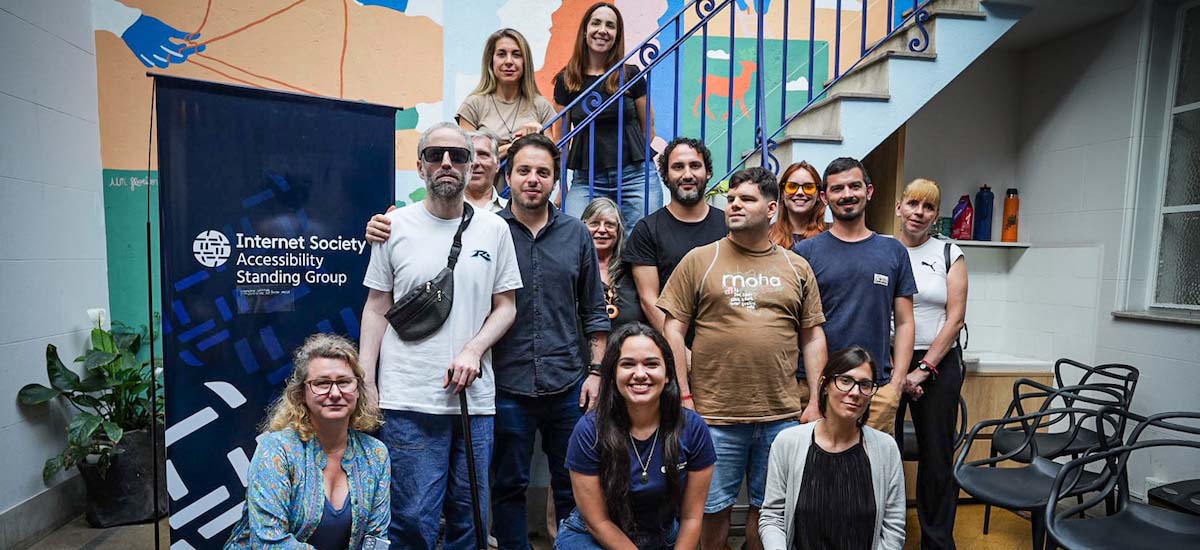
I am proud to say that the Internet Society community is living this principle across the globe. Beyond the great work of the Accessibility Standing Group, our chapters around the world are deeply engaged in this work.
Our chapter in Nepal conducted an accessibility audit of the government’s website system. Our chapter in Bosnia and Herzegovina organized Internet safety training for visually impaired students. In Niger, a new Digital Learning Center opened with a digital literacy program for people with disabilities. And in Zimbabwe, our chapter trained nearly 600 community members with disabilities in basic and advanced ICT skills.
And our Accessibility Standing Group continues to drive global conversations, including today’s GAAD 2026 International Conference on Digital Accessibility, Inclusion, and Innovation—bringing together accessibility leaders, policymakers, and innovators from around the world to advance the work.
Our Own Commitment
At the Internet Society and Foundation, we are committed to digital inclusion. Our current five-year plan focuses on building a culture of accessibility across our work. We’ve already reached extremely high automated accessibility scores for our websites, and we’re providing accessibility guidance to key community events. We have a solid plan to do even more.
Three Things You Can Do
Creating a more accessible Internet requires action from all of us—individuals, organizations, governments, and technology companies. Here are three concrete steps you can take:
- Learn the standards and apply them. Familiarize yourself with the Web Content Accessibility Guidelines (WCAG). Whether you’re building a website, developing an app, or simply posting content online, these guidelines provide clear criteria for making digital content accessible.
- Include people with disabilities from the start. When designing products, services, or policies, involve people with disabilities from the beginning—not just at the end for testing. Their lived experience provides insights that guidelines alone cannot replicate.
- Advocate for accessibility in your sphere of influence. Whether you’re making procurement decisions, participating in policy discussions, or contributing to open-source projects, make accessibility a priority. Ask vendors about their accessibility commitments, encourage your organization to adopt accessibility policies, and support initiatives that promote digital inclusion for people with disabilities.
Looking Ahead
Global Accessibility Awareness Day is a reminder that accessibility is about ensuring that the Internet fulfills its promise as a resource that enriches all lives and serves as a force for good in our society.
The work is ongoing, and we are committed to it. But we cannot do it alone. It will take all of us—working across stakeholder groups, borders, and disciplines—to ensure that people with disabilities can fully participate in our online world.
Only then can we truly say the Internet is for everyone.
If you are an Internet Society member, join the Accessibility Standing Group to get involved.
Image © Internet Society Accessibility Standing Group