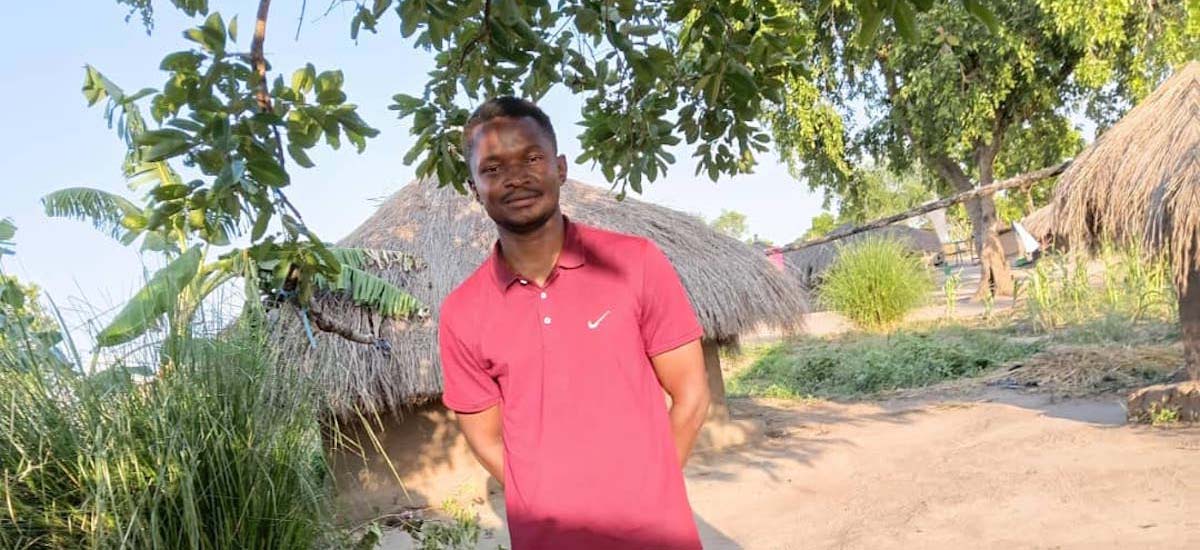

For Justin Lisisa Lobela, 28, arriving at Rhino Camp Refugee Settlement in Uganda four years ago was not part of a plan—it was an act of survival.
Before conflict forced him to flee the Democratic Republic of the Congo (DRC), Justin was a first-year law student with aspirations of defending the rights of others. But when armed groups targeted him for refusing to join them, he was forced to leave his home and family behind.
After surviving a dangerous three-week journey, Justin arrived in Uganda injured and exhausted, requiring days of medical treatment before he could begin rebuilding his life.
“It was really painful leaving my family behind,” Justin recalls. “But I had no choice. I could not see any future if I stayed.”
Today, Justin’s story reflects how community-centered connectivity can create pathways for education and self-reliance for displaced communities.
Through partnerships between the Internet Society, the Community Empowerment and Transformation Agency (CETA), Hello World, and the Research and Education Network for Uganda (RENU), Rhino Camp is becoming a model for sustainable digital inclusion led by the community itself.
Starting from the Ground Up
When the Internet Society and CETA first began digital skills training in Rhino Camp, the educational setting was basic. Students often sat on the floor of temporary classrooms, learning networking concepts using chalkboards and handwritten notes.
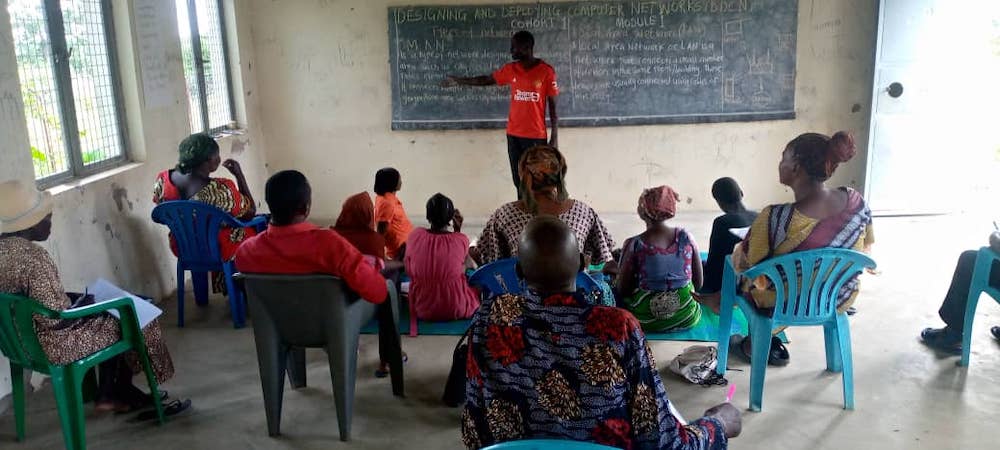
A CETA tutor conducts a training to the first DDCN cohort in the Siripi zone.
The challenges extended far beyond the classroom.
Located in a remote area of northwestern Uganda, Rhino Camp faced significant barriers to meaningful connectivity. Before community digital hubs were established, most families relied on costly mobile data bundles, often spending between USD $0.53 and $1.33 per day for limited connectivity that only supported basic messaging and occasional browsing.
Internet access was not only expensive—it was unreliable. Weak network coverage across large parts of the settlement meant students often walked long distances to find a signal strong enough to download educational materials, participate in online learning, or communicate with family members and service providers.
The lack of affordable, reliable Internet limited opportunities in education, livelihoods, and communications, while entrepreneurs had few opportunities to participate in digital marketplaces or explore online sources of income.
Recognizing these challenges, the Internet Society partnered with CETA in 2025 to launch the Designing and Deploying Computer Networks (DDCN) program. The initiative aimed to build local technical skills while laying the foundation for sustainable, community-led connectivity across the settlement.
From Student to Trainer
Justin joined the first group of learners participating in the DDCN program in 2025. The practical training combined classroom learning with hands-on experience in wireless networking, infrastructure deployment, troubleshooting, digital literacy, and online trust and safety.
During the six-week program, Justin learned how to configure MikroTik routers, troubleshoot network equipment, and support Internet infrastructure deployment. He quickly distinguished himself through his commitment, leadership, and willingness to help others learn.
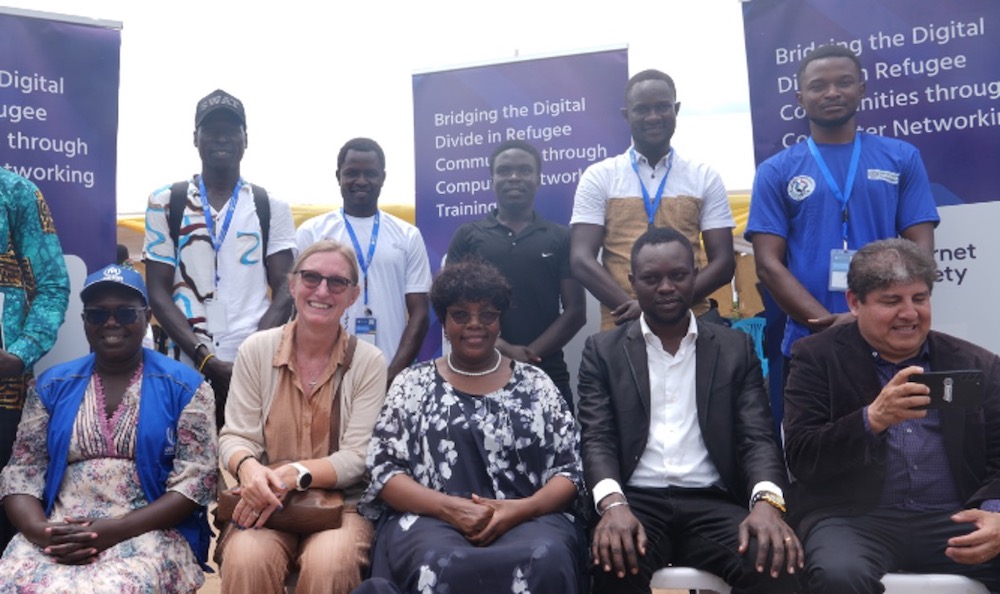
Internet Society, UNHCR, and CETA tutors attend the first cohort’s graduation.
Fluent in Lingala, Swahili, French, and English, Justin noticed that some participants struggled with English-language training materials. To address this challenge, he volunteered to translate key learning resources into French, helping make the program more accessible to fellow refugees. His initiative and technical ability did not go unnoticed.
After graduating as one of the strongest performers in his training group, Justin began supporting subsequent learner groups as a peer mentor and trainer. In January 2026, he was offered a tutoring and mentorship role with CETA, where he now helps facilitate practical networking sessions, mentor new learners, and support community connectivity training across Rhino Camp.
His journey from learner to trainer reflects the long-term vision behind the program: developing local talent capable of sustaining and expanding connectivity solutions within their own communities.
Building Connectivity through Partnerships
The transformation of Rhino Camp’s connectivity ecosystem has been driven through collaboration. The journey began with a partnership between the Internet Society and CETA to strengthen local technical capacity and prepare refugee and host-community members to build, maintain, and manage their own connectivity solutions.
Building on this foundation, Hello World joined the initiative to deploy solar-powered community Internet hubs and support infrastructure implementation. RENU provided the backbone connectivity that powers the hubs, helping deliver reliable, high-quality Internet access across the settlement.
The initiative also reflects a broader collaboration across the Internet Society ecosystem. Alongside capacity development and connectivity efforts, the project has benefited from partnerships with Hello World and RENU, both recipients of support through Internet Society Foundation grant programs.
By bringing together community leadership, infrastructure, technical training, and grant-funded partnerships, the initiative has created a sustainable model for digital inclusion that is expanding meaningful connectivity opportunities for refugee communities.
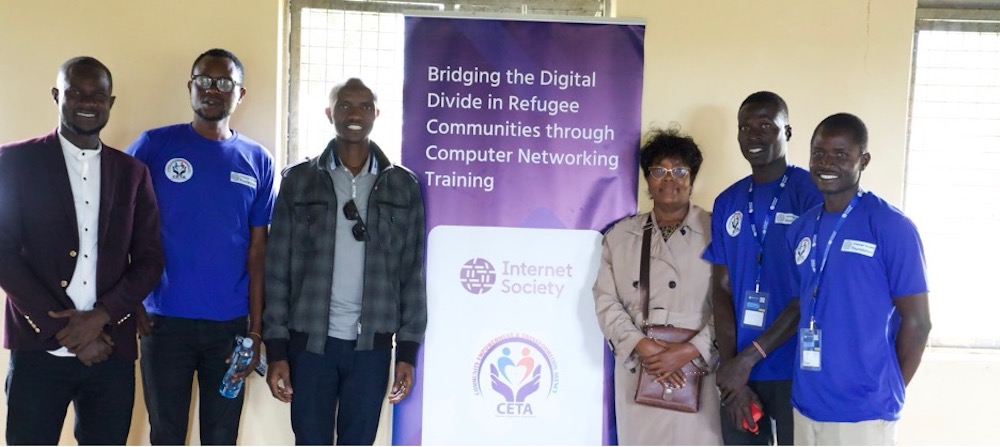
The Internet Society and CETA team make a joint project site visit.
Justin was directly involved in this transformation. As connectivity infrastructure was deployed across the settlement, he helped install solar systems, support network deployment activities, and configure equipment alongside technical teams. For him, the partnership model helped build something even more important than infrastructure: trust.
“Hello World did not just come to install the Internet and leave,” Justin says. “They shared skills, knowledge, and even meals with us. That created trust.”
Today, community members are increasingly able to maintain and troubleshoot the infrastructure themselves.
“If there is a technical issue, we do not need to wait for an engineer from Kampala,” Justin explains. “We can fix it ourselves.”
Connecting Communities, Expanding Opportunities
Through solar-powered community hubs connected to a 20 Mbps backbone and supported by wireless mesh networks, refugees and host-community members can now access stable, high-speed Internet directly within their communities.
Access costs have also fallen significantly. Through community-managed voucher systems, users can now access 24-hour unlimited Internet for approximately USD $0.19–0.27, making connectivity far more affordable than before.
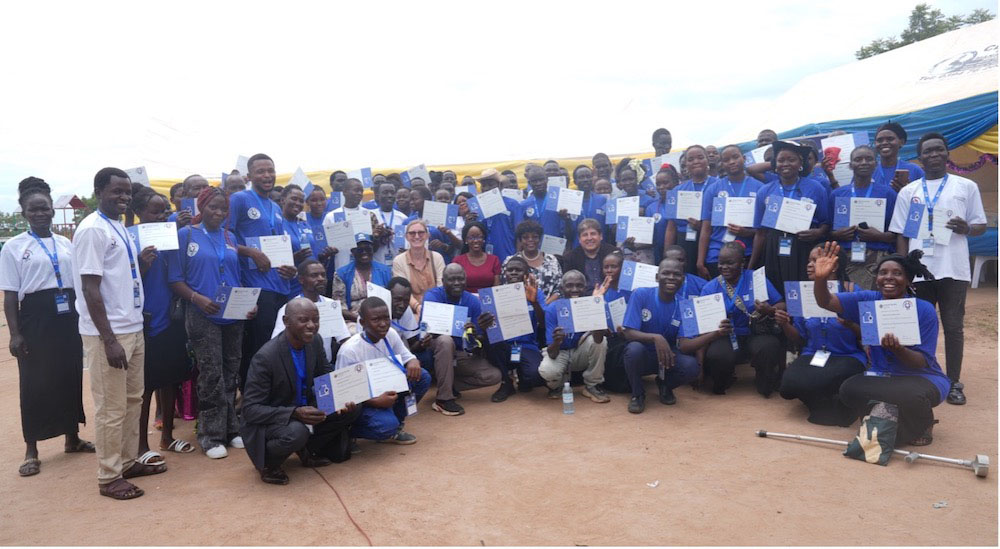
The first cohort gathers for a graduation ceremony in the Siripi zone.
The impact of connectivity in Rhino Camp extends far beyond Internet access. According to Justin, the impact is also visible in everyday life.
“The availability of the Internet has reduced theft because young people are now engaged in positive and productive activities,” he says.
Young people now use the hubs to search for scholarships, apply to universities, access online courses, and continue learning beyond the classroom. Others are developing digital skills, exploring entrepreneurship opportunities, and strengthening connections with family members across borders.
The DDCN program has also continued to grow. What began with an initial group of 135 learners has expanded across multiple locations within the resettlement. Many graduates have gone on to become digital champions, peer mentors, and local connectivity support personnel, helping strengthen community ownership of digital infrastructure throughout the settlement.
For Justin, connectivity brought something equally meaningful: reconnection. Through the Internet, he was able to reconnect with extended family members and learn what had happened to his father during the conflict in the DRC.
Despite the hardships he has faced, Justin remains focused on the future. He is currently teaching himself Spanish and sign language online so he can support even more members of his community, including persons with disabilities.
His story reflects the broader vision behind community-led connectivity: when communities are equipped with the skills, infrastructure, and support they need, connectivity becomes more than access—it becomes a pathway to opportunity, resilience, and self-reliance.
Today, an estimated 7,900 people are benefiting from connectivity through the initiative, demonstrating how local leadership and strong partnerships can help build a more connected future for refugee and host communities alike.