

The COVID-19 pandemic has proven how important a strong Internet infrastructure is.
Internet exchange points are a vital part of that. They are key to bringing better, faster, and more affordable Internet to people.
Recently, the Asia Pacific Internet Exchange Association (APIX) and the Internet Society did a comprehensive survey to understand the impact of COVID-19 on IXP operations in the region.
IXPs from Japan, Hong Kong, Taiwan, Thailand, Myanmar, Philippines, Singapore, Vietnam, Indonesia, Malaysia, Nepal, and Australia provided data. Here are some of the key findings.
What is an Internet Exchange Point?
If you want to see your neighbor, taking a route that sends you across town and back again is not the quickest or most efficient way to get there. And yet, in many parts of the world, that is what happens with Internet traffic. IXPs help create shorter, more direct routes for Internet traffic.
Read the Explainer
Changes in Internet Traffic
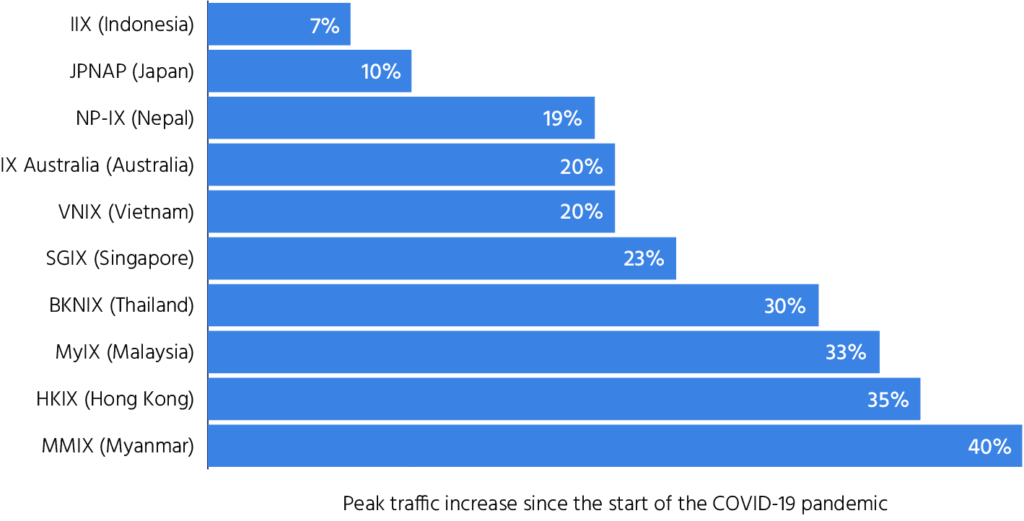
There was a significant increase in Internet exchange traffic, between 7- 40%. Traffic patterns during the pandemic show that there is either no difference left between peak and off-peak time or the peak time has increased from a few to more hours.
The increase is highest for various types of traffic including video conferencing, online gaming, Internet banking, online shopping, and video streaming platforms (Amazon, Netflix, YouTube).
Impact on IXP Operations
There was no downtime recorded for IX traffic operations, but due to lockdowns their physical technical support, maintenance, and work on upgrades did suffer. The technical teams continued the management and operations work from home. As lockdowns are opening their support work is gradually coming back to normal.
There were no changes in peering policies, but some of the emergency actions (policy/industry) included:
- The national broadband network (wholesale L2 network provider) in Australia gave a 40% uplift on all traffic, for the same price.
- YouTube degraded their video quality from HD to SD in Japan, which helped eyeball networks.
Sharing more, the IXPs said some of their members required urgent upgrades to 10 or 100 GE (Gigabit Ethernet) ports. While they described this time as a great period of cooperation among peering community, IXPs and operators should plan ahead and prepare.
Learn how IXPs in Asia-Pacific support the local Internet infrastructure during COVID-19. Watch the webinar with some of the leading IXPs in the region:
Internet Exchange Points are vital to bringing faster and more affordable Internet to people. Learn how you can support them!
Image by Brazil Topno via Unsplash