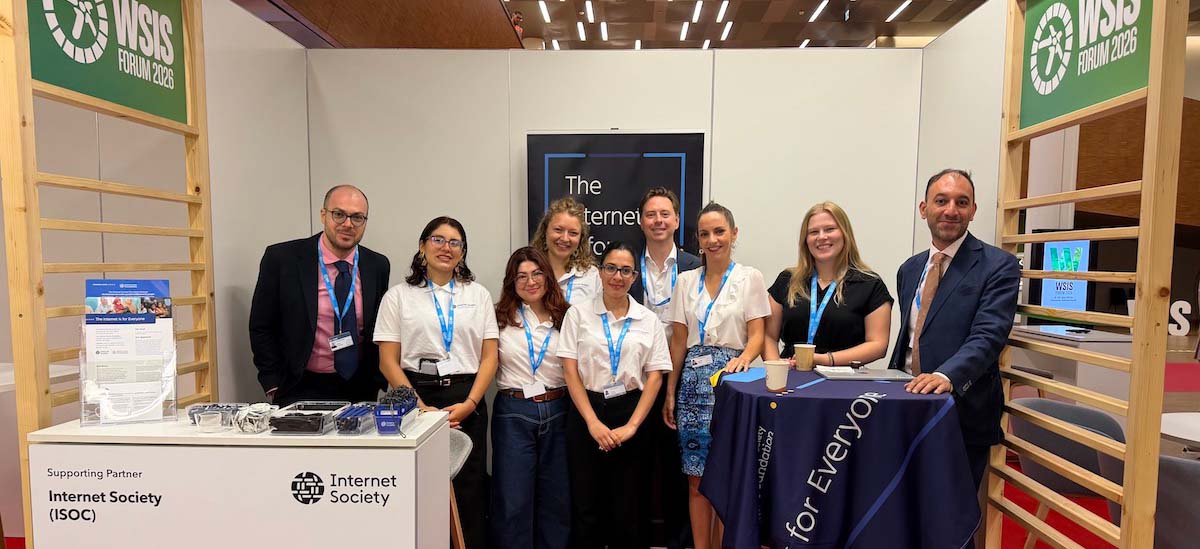

The World Summit on the Information Society (WSIS) Forum 2026 confirmed that there is a strong appetite for global collaboration on digital development. But it also highlighted the need to rethink how the forum turns global commitments into measurable results.
With the WSIS+20 review complete and a new mandate for implementation roadmaps on the table, the coming year is an opportunity to refocus the forum on its original purpose: driving and reviewing the implementation of the WSIS Action Lines. In a recent non-paper, we set out what such roadmaps could look like in practice.
Last week was the first WSIS Forum since the WSIS+20 review concluded in December 2025. That review reaffirmed the multistakeholder model of Internet governance, made the Internet Governance Forum (IGF) permanent, and confirmed the WSIS Action Lines as the main reference for the decade ahead. After a year of negotiations, this was the moment to turn the momentum of 2025 into action—and expectations were rightly high.
The week demonstrated the strength of a committed WSIS community, but it also exposed clear challenges. The forum took place amid an increasingly crowded digital-policy landscape, alongside the UN Global Dialogue on AI, the AI for Good Global Summit, and a wider wave of AI-related events in Geneva. The decision to split the WSIS Forum across two venues only reinforced the sense that it had taken a back seat.
That matters because the WSIS agenda is not a sideshow to the AI moment—it is its foundation. As we have argued before, without the Internet, there is no AI, and how we steward the network shapes every technology built on it. Yet many of the fundamental challenges at the heart of the WSIS agenda persist. Its vision of a people-centered, inclusive, and development-oriented information society encompasses questions of connectivity, infrastructure, capacity, trust, and participation that are as urgent today as they were 20 years ago. The task is to turn these global commitments into meaningful progress.
Putting Implementation Back at the Heart of the WSIS Forum
When the second phase of the World Summit on the Information Society (WSIS) concluded in Tunis in 2005, governments had reaffirmed the 11 Action Lines agreed in the 2003 Geneva Plan of Action—including work on infrastructure, access, capacity building, and security—and assigned UN agencies to facilitate the implementation of each one.
The WSIS Forum grew out of these commitments, bringing these efforts together to take stock of progress. This kind of rigorous stocktaking may not always attract the greatest attention, but it is the forum’s core purpose. A structured annual review can keep implementation of the Action Lines in focus, identify where progress is falling short, and help stakeholders determine what needs to happen next. It is also what should set the forum apart.
Empowering the WSIS Community to Deliver
The organizers of the WSIS Forum, led by the International Telecommunication Union (ITU) and the Action Line facilitators, run an engaging event on limited resources, and drawing thousands of participants each year is an achievement in itself. The commitment of the people involved was clear throughout the week.
The opportunity now is to match that commitment with stronger structures for implementation and accountability. The Action Line sessions, which should anchor the week, still run in short slots against many parallel events. The facilitators themselves have recognized the need for a common framework to monitor implementation across the Action Lines. This is not a failure of any one actor or institution, but a gap in the tools available to the WSIS community—and one it is now well placed to address.
The Role of Roadmaps
The good news is that the WSIS+20 outcome provides a way forward. Paragraph 113 calls on the Action Line facilitators, working with the UN Group on the Information Society (UNGIS), to develop result-oriented implementation roadmaps, with targets, indicators, and metrics.
UNGIS should take full advantage of this opportunity. In our non-paper, we describe what such roadmaps could look like and provide an example for Internet exchange points (IXPs). Roadmaps should be specific enough to track individual commitments under each Action Line, with indicators focused on meaningful outcomes—people connected or infrastructure deployed, not simply workshops held.
The institutional timing is also right. As the UN80 reform initiative challenges the UN system to demonstrate impact while making better use of limited resources, and to show measurable results, indicator-based roadmaps are how the WSIS process can demonstrate its value while also focusing scarce time, funding, and attention on shared commitments. They could also support the UN’s work when progress on the Sustainable Development Goals (SDGs) is assessed in 2030.
Roadmaps built this way would give the forum natural focal points of agreed measurements, milestones, and targets. They could move discussions beyond reporting and towards assessing real progress, openly identifying successes and gaps, and planning what must happen next.
Just as importantly, these roadmaps should be developed and reviewed through genuinely multistakeholder processes. Governments and UN agencies cannot deliver the WSIS vision alone. The technical community, academia, civil society, the private sector, and local communities themselves bring knowledge, experience, and evidence essential to understanding what works, where gaps remain, and what needs to change.
Reimagining the WSIS Forum for 2027
The path forward is to build the WSIS Forum around the new roadmaps, giving Action Lines implementation the time they need and making fuller use of a multistakeholder approach. In practice, that might mean fewer workshops and more space for the Action Line facilitators.
This is not a retreat from inclusion. The number of workshops is not necessarily the best measure of multistakeholder dialogue. Instead, roadmaps give every stakeholder something concrete to engage with, such as a specific commitment, indicator, or gap. As the São Paulo Multistakeholder Guidelines from NETmundial+10 note, multistakeholder collaboration works best when oriented toward “practical, actionable outcomes” that lead to tangible results.
Workshops still have an important role. They can bring in new voices and surface insights the formal sessions would miss. But their value would be even greater if they were clearly connected to the roadmaps rather than competing for attention as loosely connected sessions. A workshop tied to a specific commitment, gap, or indicator can feed directly into implementation and help shape what happens next.
In a reimagined forum, the high-level track that currently takes up much of the agenda could serve a clearer purpose: responding to the evidence and gaps emerging from Action Line discussions, securing commitments, and demonstrating accountability for implementation. A forum with that kind of substance would not need to worry about being overshadowed by other events. By bringing together clear targets, meaningful participation, and accountability, the forum could turn global commitments into measurable progress.
The mandate exists. The first roadmaps are due next year. The WSIS community has shown, over more than 20 years and through a demanding global review, remarkable dedication. The task now is to put that dedication to work: roadmaps built with all stakeholders and a 2027 forum designed around them.
That is how the WSIS Forum becomes the place where digital commitments turn into results.
Image © Internet Society