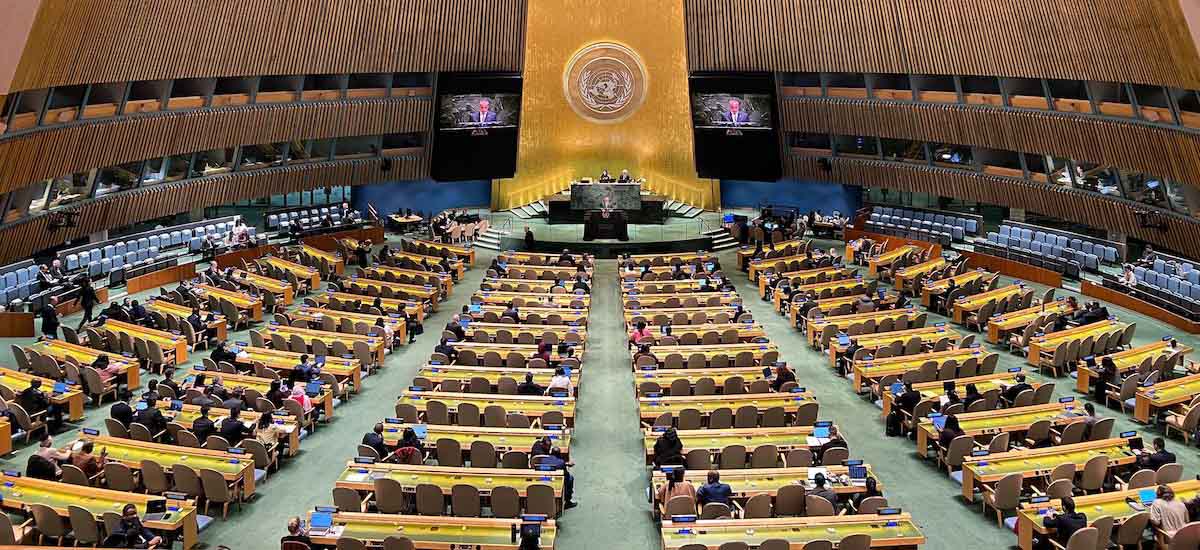

This past Wednesday, 17 December, the governments gathered at the United Nations agreed on their vision for the future of the digital ecosystem, including the Internet.
By adopting the outcome document of the World Summit on the Information Society (WSIS)+20 review, they reaffirmed their commitment to the conditions that have enabled the Internet to thrive: a model that allows for the inclusion of diverse expertise—the multistakeholderism approach—paired with a permanent mandate for the Internet Governance Forum.
This decision is a significant victory and a recognition of the conditions that have made the Internet such a successful, collective project.
The WSIS+20 Review in Retrospective
The timing of this process was set 10 years ago, during the WSIS+10 review. In 2015, the United Nations General Assembly requested an intergovernmental process, involving all stakeholders, to assess the implementation of the WSIS outcomes by 2025.
A lot has happened since then: the NETmundial+10 meeting outlined some guidelines to increase multistakeholder participation in intergovernmental processes, and the United Nations adopted the Global Digital Compact. Most importantly, the Internet continued to evolve, demonstrating its potential to transform people’s lives. A lot was at stake during the WSIS+20 review.
WSIS+20: What It Means for the Internet
While the outcome document is a lengthy resource, there are some immediate takeaways that are worth noting.
- It makes the Internet Governance Forum (IGF) a permanent forum of the United Nations. By securing a lasting mandate, the IGF community is now ready to plan for the long term, including sustainable financing and a clear program path. The Internet Society and its community stand ready to help shape that next chapter.
- It reaffirms the importance of the WSIS framework, including the Tunis Agenda’s working definition of Internet governance—which underpins the multistakeholder model—and the WSIS Action Lines—which turn that vision into a practical implementation program.
- It establishes a “joint implementation roadmap” to align the WSIS+20 follow-up with the Global Digital Compact (GDC), ensuring that future governance efforts remain unified rather than fragmented.
- It recognizes the importance of the global network of national, regional, and youth IGF initiatives (NRIs),validating the grassroots work of our community.
In practice, this means a continuation of a stable, global Internet governance ecosystem. One made up of people and organizations from across governments, academia, civil society, industry, and the technical community. It means a permanent mandate for the single most open and inclusive forum in the history of the United Nations, the IGF. And it means that our efforts over the past year to defend an Internet for everyone have been successful.
But it’s just the end of a process. Not the end of the road. 2.2 billion people worldwide are waiting for us to help bring them online. In the coming weeks, together with our community, we will continue to analyze the outcome document and share key insights on our social media channels and on our blog.