Summary
The Internet is facing shifts towards centralization in peering, manifested in two main trends: tiered selective peering models and virtual peering at distant Internet Exchange Points (IXPs). Although these offer wider peering options to privileged networks with promises of high-level reliability, it hollows out local infrastructure, entrenches monopolies, and creates single points of failure that risk leaving entire countries vulnerable to outages.
These trends also add a latency tax on routing local traffic, or traffic that could have been local with local peering, through international hubs, and erode local neutral IXPs. We argue that the path to a truly resilient Internet is through inclusive, physically local, and neutral interconnections, and not through virtual shortcuts.
The Resilience Trap
The Internet is not a single, monolithic entity. It is, and has always been, a network of networks. This fundamental truth has allowed the Internet to scale, connect billions, and foster global collaboration that transcends borders. However, we are currently witnessing a shift that threatens this very foundation: a move toward centralized, tiered, private peering and growth in remote or virtual peering that risks hollowing out the very infrastructure it claims to enhance.
The benefits of peering at local IXPs are well-documented. Research consistently shows that networks that interconnect through a diverse mesh of peers increase their resilience. By not depending on any single network for global access, the Internet remains robust even when individual links fail.
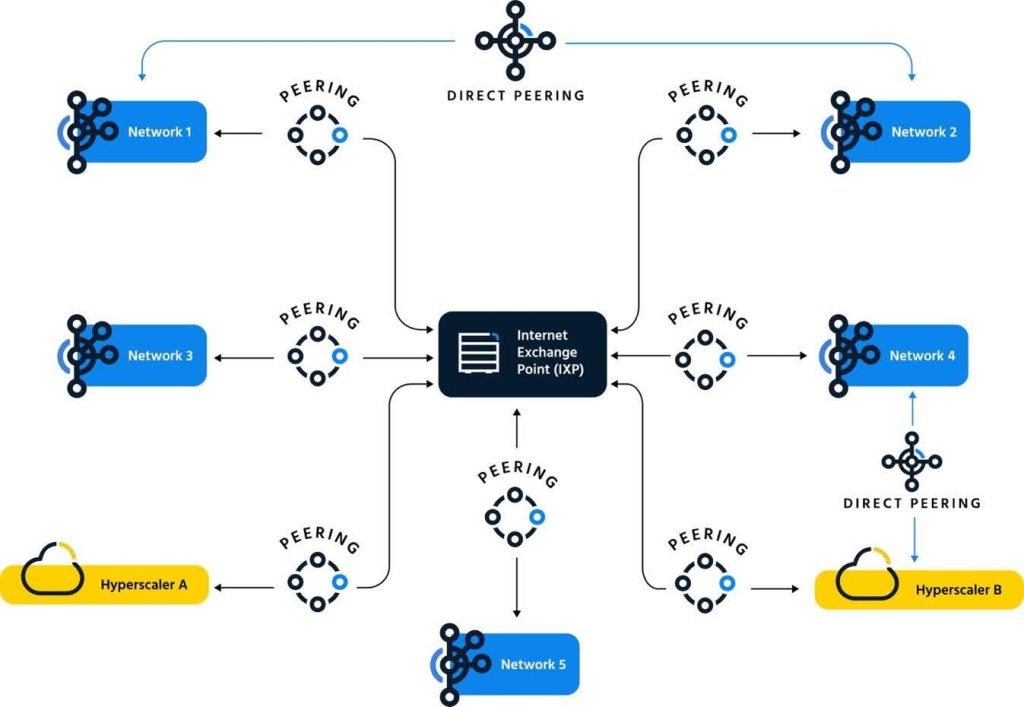
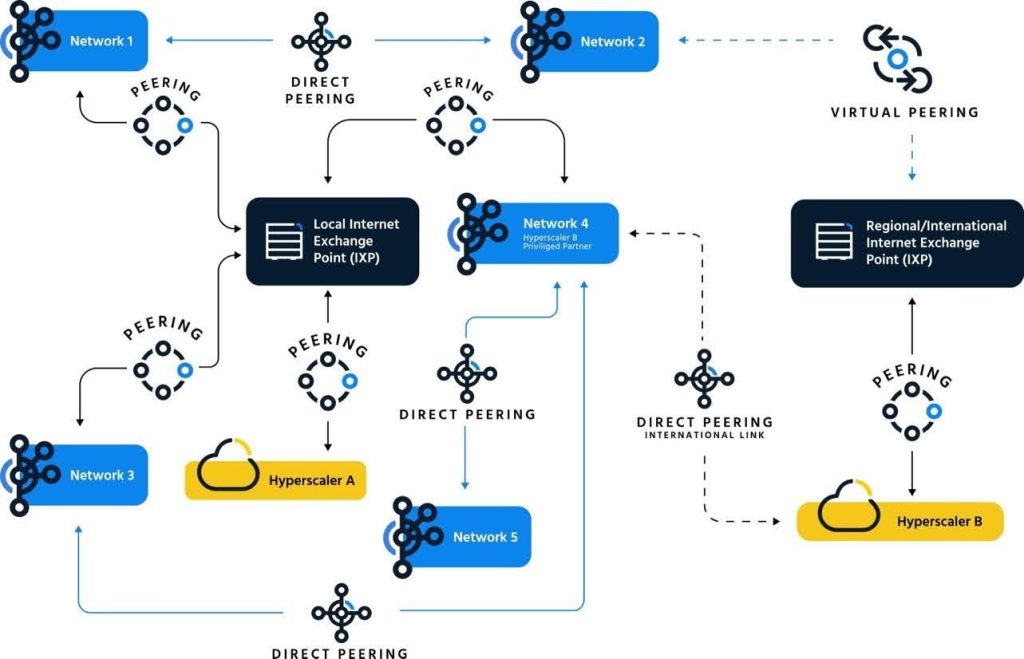
When major networks shift toward tiered private peering through selective privileged partners, as with Google’s Verified Peering Provider (VPP)[1] model or Vodafone’s arrangement with Inter.link[2], they follow the promise of higher reliability with “enterprise-grade connectivity.” But in reality, they effectively reduce their local footprint. This creates a less distributed architecture with new toll gates rather than a resilient open mesh. We only need to look at the massive outages experienced by TIM in Italy[3] to see the danger.
Direct peering, as with Private Network Interconnections (PNI), is a legitimate way of making the Internet work. But creating a tiered system that is biased towards dominant market players, monopolies, and duopolies, puts the network at risk.
In a country where traffic is concentrated through a few large transit paths, a single failure doesn’t just affect one provider; it exacerbates the impact for everyone. With this in mind, we must ask: If a single VPP-style agreement concentrates 70% of a market’s eyeball traffic into a proprietary hand-off, is that network still part of the wider, open Internet, or has it become a single point of failure for the state?
During the 2022 Rogers outage[4], nearly 25% of Canada’s total Internet connectivity vanished. Are we willing to accept similar ratios in developing markets?
Remote Peering, The Mirage of Locality
Parallel to this shift is the rise of Remote Peering and Cross-IXP connectivity. On paper, these services offer a compelling value proposition: Connect to multiple global exchanges through a single port. It seems to be effective, scalable, and to reduce the barrier to entry for smaller networks.
But there’s a catch.
When a network in Lusaka or Nairobi peers with a content provider in Marseille via a Cross-IXP arrangement, the traffic appears to be peered locally, but the locality is a mirage. The data still travels thousands of kilometers through international transit or subsea cables to reach the exchange. This maintains a persistent, invisible reliance on international transit links.
This virtual interconnection doesn’t contribute to the goal of keeping local traffic within the borders of the country where it is generated, as with our 50/50 vision. Instead, it bypasses the development of local data centers, local fiber, and local technical expertise. It allows a market to be connected without ever becoming resilient.
Even if we put aside the financial cost of transit over fiber, if a packet travels 12,000 km to Amsterdam just to cross the street in Lusaka, who is actually paying for the loss in efficiency? At what point does the 150ms latency tax of remote peering become a common quality-of-service feature in a country’s digital services?
Entrenching Monopolies
One of the most concerning side effects of these selective policies is how they favor the largest operators. By setting high technical or commercial thresholds for direct local peering, these policies essentially gatekeep the Internet’s most valuable quality: openness.
In many countries, this means entrenching existing monopolies or duopolies. Large incumbents and mobile operators meet the criteria, while small-to-medium Internet service providers (ISPs) and community networks are left out in the cold. These smaller players are forced to access content through expensive IP transit or remote peering, a cost that is inevitably passed on to the end user. This doesn’t just stifle competition; it widens the digital divide for marginalized communities who rely on these local initiatives for affordable access.
Are high-threshold peering policies a legitimate technical requirement, or are they a form of digital redlining? If the top five content providers only peer with the top two ISPs, can a competitive market even exist, or are we subsidizing incumbents at the expense of users, including the unconnected?
The IXP Identity Crisis
IXPs thrive on neutrality. They are the town squares of the Internet. However, the move toward selective privileged peering and as-a-service peering is pushing some IXPs into a corner. We are seeing scenarios where IXPs are being pressured to become transit providers for smaller members who can no longer meet the requirements of major content networks.
This shift is dangerous. It fractures the local peering community and raises difficult regulatory and neutrality questions: Should a neutral IXP be licensed as a transit provider? If an IXP loses its neutrality, it loses its soul, and its ability to protect the local ecosystem from commercial interests.
Can an IXP remain a neutral point of contact and community enablement if it begins selling the very transit its members are trying to avoid and others are selling? Where is the line between value-added services and community cannibalization?
A Lifeline Under Threat
Perhaps the most critical risk is one we see too often: artificial Internet limitations manifested as shutdowns[5].
In a decentralized network with diverse local peering, the Internet is harder to shut down. In many cases, local services could still operate despite the international disconnection.
During the Kenya Internet shutdown in June 2024, we saw how ripple effects can hit neighboring countries. However, we have also seen instances where private operators and neutral IXPs have pushed back or remained online, providing a vital lifeline.
If we allow the network to become centralized, in a scenario where only a few large incumbents serve as the transit path for everyone, and where peering happens in distant cities and countries, we make it easier for a State to flip the switch and isolate an entire population and vital services.
In a centralized architecture, a kill switch can be a single line of code. In a mesh-peered ecosystem, there can be a thousand manual interventions, and even then, some local services may still be available.
If your nation were disconnected from the global subsea cables tomorrow, what percentage of your local government and banking services would stay online? For many, the answer is a sobering 0%.
Securing the Peering Ecosystem
To protect the Internet’s global reach and local resilience, including the sanctity of local peering, we must address these peering trends, not as isolated business decisions, but as architectural shifts that affect us all. Our focus must remain on strengthening the local peering foundations that allow the Internet to thrive by:
Prioritizing Physical Locality
While services like Cross-IXP and remote peering offer a perceived ease of entry, they are no substitute for a physical, local presence. We must encourage networks and content providers to invest in local landing points and physical ports at local IXPs. True resilience is not found in a remote virtual connection to a distant hub, but in the ability of a local network in Lusaka or Lagos to reach its neighbor without ever leaving the country’s borders.
Advocating for Inclusive Peering Policies
We need to move away from the all-or-nothing approach seen in selective privileged peering models, as with VPP. Large content providers and transit giants should adopt inclusive peering requirements that recognize the value of small-to-medium ISPs and community networks. When the thresholds for peering are set too high, we don’t just exclude small networks, but also fragment the local market and force traffic onto expensive, less resilient transit paths. Peering should be a tool for growth, not a barrier to entry.
Protecting IXP Neutrality and Community Governance
The IXP is not just a switch. It is a community anchor. To counter the trend of IXPs being pushed into the role of transit providers, we must uphold the neutrality of the exchange. This requires robust community governance models where decisions are made by the local technical community, not by commercial interests alone. A neutral IXP also plays a role in promoting collaboration and coordination needed to catalyze technical and policy development and evolution, and fostering local innovation. In turn, it ensures that all participants compete on a level playing field.
Rejecting Distortive Interconnection Mandates
As we have seen in South Korea and the ongoing debates in Europe, any move toward Regulated Traffic Obligations (RTOs), often marketed as Fair Share, is a direct departure from the Internet Way of Networking. These proposals rely on a factually flawed premise: that content providers push traffic onto networks. As we have discussed in our policy brief on Interconnection and Regulated Traffic Obligations, Internet traffic is a consequence of user demand. It is pulled by the end-user, who has already paid their ISP for the capacity to receive it.
In South Korea, where sender-pays was implemented, transit costs ballooned to roughly 10 times higher than in Europe or North America, leading major platforms like Twitch to exit the market and degrade the quality of service for local citizens.
If we shift toward a model of cross-network responsibility, where a service provider is forced to pay for a network they do not control, do we effectively end the era of the global startup? How can a small content provider in Manama or Nairobi reach a global audience if they must first negotiate a separate commercial toll with every ISP on the planet?
Policymakers must reject these distortive mandates and reaffirm their commitment to the voluntary, market-driven nature of peering that allows the Internet to remain a unified, global resource.
Conclusion
The trend toward de-peering, selective privileged peering, and remote virtual locality represents a choice. One path leads to a tiered Internet that is expensive, fragile, and easy to disrupt. The other path, the one we advocate for, leads to a decentralized, resilient, and locally-rooted Internet.
The way we interconnect defines the strength of the whole. By investing in local IXPs, adopting inclusive peering policies, and protecting the open nature of the network, we ensure that the Internet remains a global resource that belongs to everyone, regardless of where they are connected.
We must reject commercial pressures that favor the few over the many and consider other aspects that are necessary to maintain the Internet a global success, even at times of turbulence. We must preserve the voluntary and open nature of interconnection that has made the Internet a global success.
The Internet is for everyone. Let’s make sure the architecture stays close to home.
Endnotes
[1] See “Introducing the Verified Peering Provider program, a simple alternative to Direct Peering” https://cloud.google.com/blog/products/networking/verified-peering-provider-simplifies-enterprise-connectivity
[2] See “Vodafone selects Inter.link to enhance interconnection with other Internet service providers” https://www.vodafone.com/news/newsroom/technology/vodafone-selects-inter-link-to-enhance-interconnection-with-other-internet-service-providers
[3] See “Italy’s Internet Outage a Perfect Storm”, by Massimiliano Stucchi on https://pulse.internetsociety.org/en/blog/2023/02/italys-internet-outage-a-perfect-storm/
[4] See “Rogers Outage: What do we Know After Two Months?” by Jim Cowie on https://pulse.internetsociety.org/en/blog/2022/09/rogers-outage-what-do-we-know-after-two-months/
[5] See “Internet Society’s Policy Brief on Internet Shutdowns” https://www.internetsociety.org/resources/policybriefs/2025/internet-shutdowns/