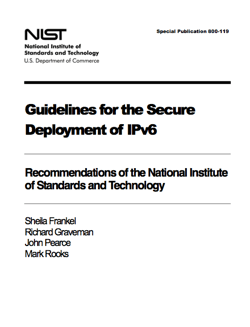
 The United States National Institute of Standards and Technology (NIST) created an excellent “Special Publication” related to IPv6 security called:
Guidelines for the Secure Deployment of IPv6
Like most of NIST’s special publications, including their excellent guide to DNSSEC, the document begins with a lengthy tutorial about IPv6 and how it compares to IPv4. The document then walks through a number of IPv6 security issues in great detail. As the title implies, a large part of the document is focused on how to deploy IPv6 securely, and includes detailed sections on the many different IPv4-to-IPv6 transition mechanisms.
It concludes on the very positive note:
Security risks are inherent during the initial deployment of a new protocol such as IPv6, but mitigation strategies exist and many of the residual risks are no different from those that challenge existing IPv4 networks.
And then goes on to provide lengthy appendices fully of definitions, references and links to learn more.
While written for the audience of US federal agencies, this document is an outstanding reference for anyone seeking to understand how to securely deploy IPv6 within their networks.