Executive Summary
Internet shutdowns have emerged as a prominent instrument for governments to impose sweeping digital censorship or manage perceived emergencies.[1] Ordered or carried out by governments, these deliberate disruptions of Internet access silence dissent, disrupt economies, and sever people from essential services, often without public justification or legal accountability.[2]
The Keep It On Coalition defines an Internet shutdown[3] as an intentional disruption of Internet or electronic communications, rendering them inaccessible or effectively unusable for a specific population or within a location, often to exert control over the flow of information. Internet shutdowns restrict freedom of expression, information, and association, as well as economic, social, and cultural rights. In many situations, the restricted communications and information flows can put people’s health and safety at risk.
This reflects a broader human rights concern. In 2016, the UN Human Rights Council directly condemned “measures to intentionally prevent or disrupt access to or dissemination of information online in violation of international human rights law,” calling on countries to refrain from and cease them (Resolution A/HRC/RES/32/13).
Tracking shutdowns is therefore critical for improving Internet resiliency, documenting patterns of digital repression, and understanding a rapidly evolving threat to human rights online.
This report highlights Internet shutdown trends from 2019 to 2025, and was part of a larger effort to audit and update the Internet Society Pulse shutdown dataset. The work by the VEsinFiltro team at Conexion Segura y Libre supported data migration efforts, strengthened data consistency, and evaluated Internet shutdowns using a new scale of verification levels.
The analysis finds that Asia and Africa are the most severely impacted regions, accounting for the most Internet shutdown events and the longest cumulative durations across the dataset. Overall, the reviewed incidents span 61 countries across five continents, reflecting the global scale of the problem.
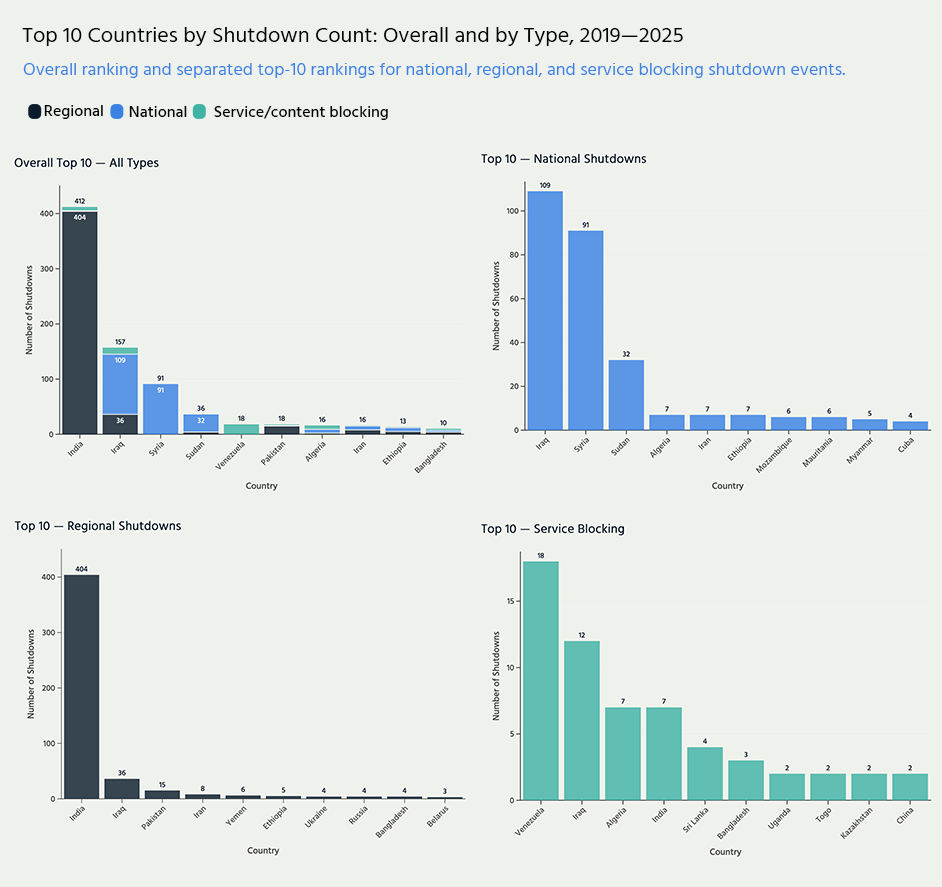
India is by far the country that has implemented the most Internet shutdowns, over twice as many as the next country, Iraq. India’s shutdowns are almost exclusively regional, often affecting specific districts and local administrative areas below the state level.
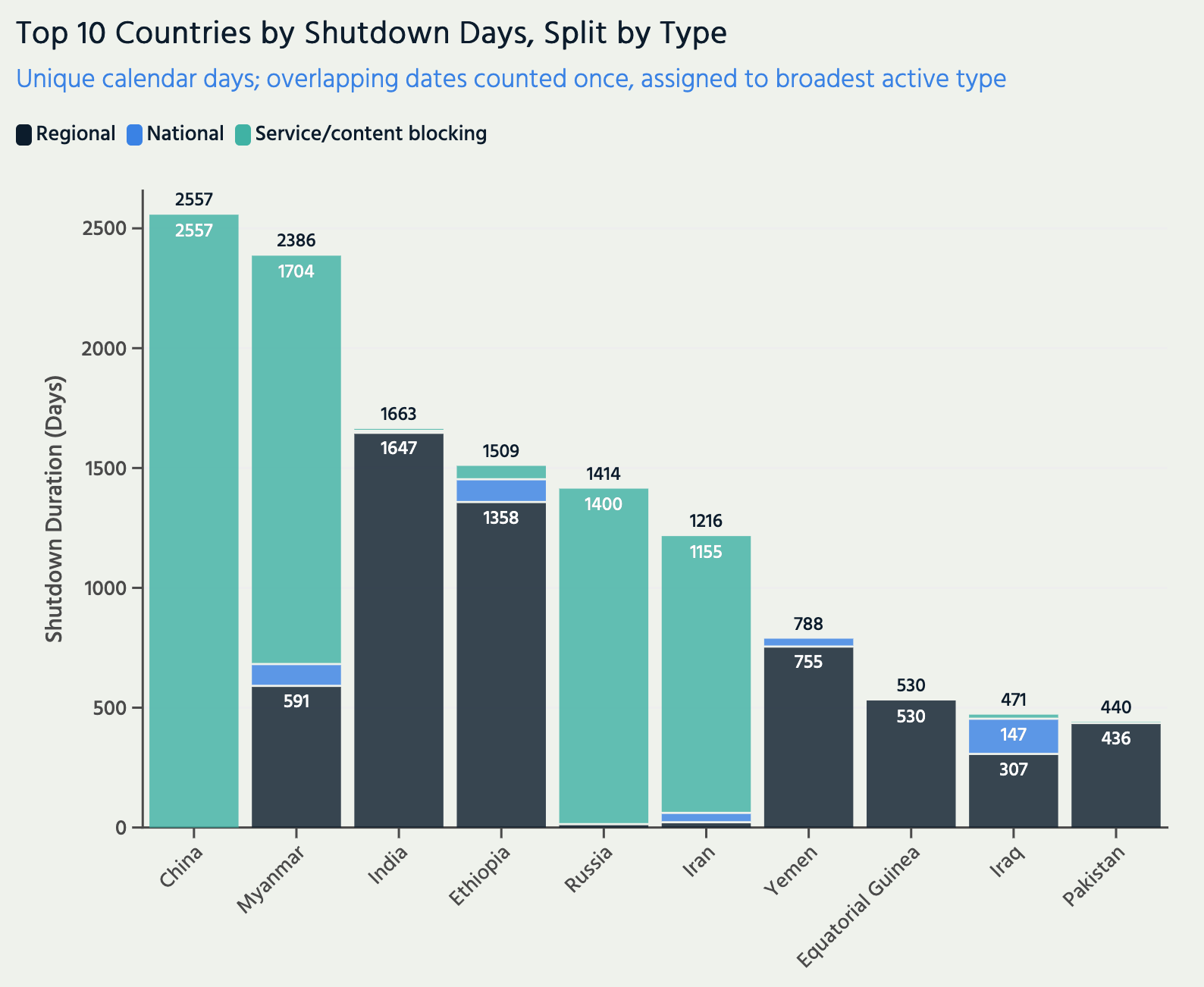
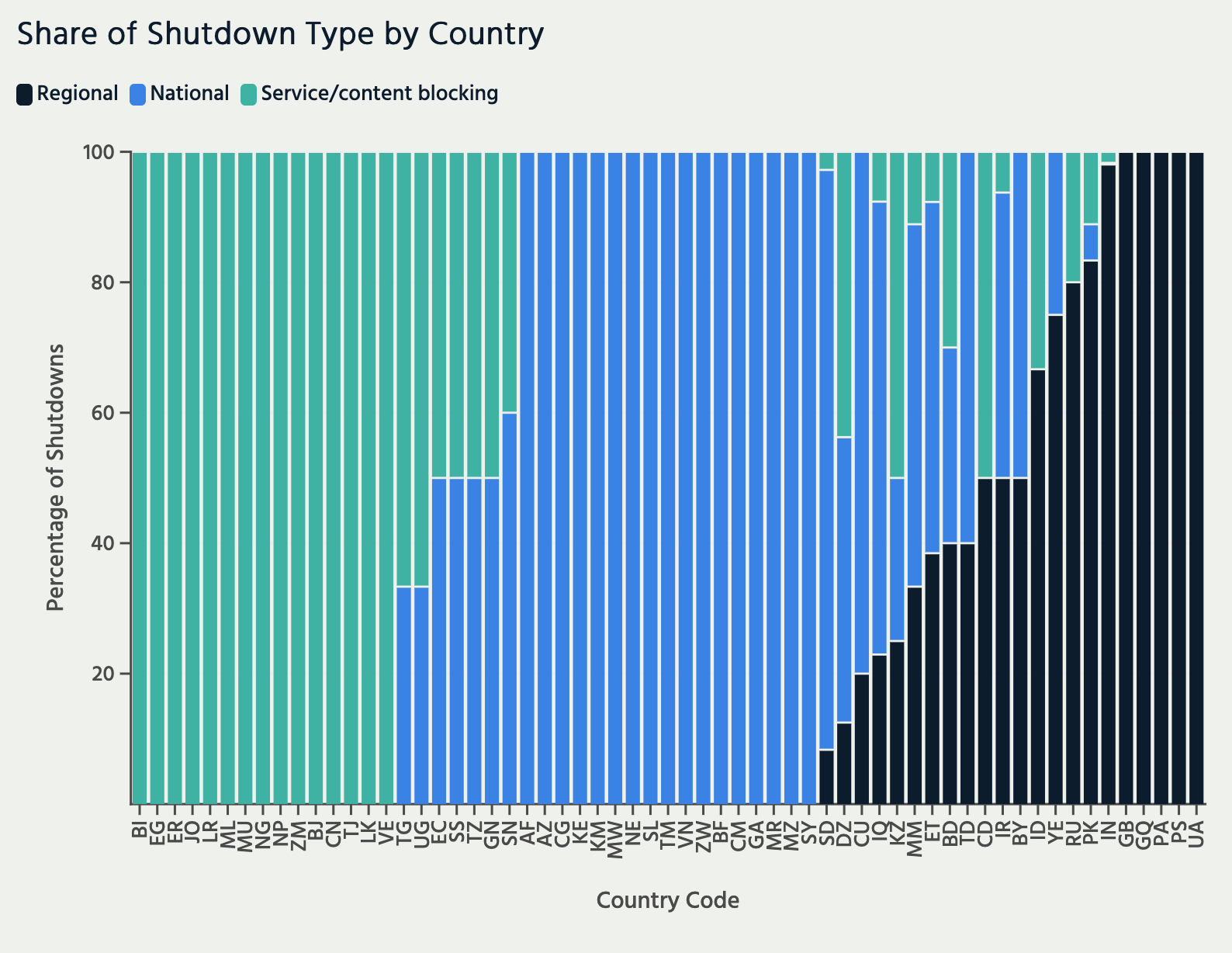
The countries that spent the most time under shutdown conditions are not necessarily the same as those with the highest count. Using calendar days,[4] counting overlapping shutdowns only once, the country with the most days under an Internet shutdown is China, from the longest-running case in the dataset.
The analysis in this report highlights the growing challenge of distinguishing deliberate disruptions from unintentional outages caused by critical infrastructure failures.
The report also identifies a concerning normalization of Internet shutdowns and related restrictions. This includes long-running blocks, such as those documented in China, Myanmar, and Iran, as well as the emergence of increasingly routine justifications, notably the use of shutdowns during public exams in countries like Algeria, India, Iraq, and Syria.
Endnotes
[1] OHCHR, Internet Shutdowns: Trends, Causes, Legal Implications and Impacts on a Range of Human Rights, UN Doc. A/HRC/50/55 (Geneva, 13 May 2022), https://www.ohchr.org/en/documents/thematic-reports/ahrc5055-Internet-shutdowns-trends-causes-legal-implications-and-impacts
[2] OHCHR, Internet Shutdowns: Trends, Causes, Legal Implications and Impacts on a Range of Human Rights, UN Doc. A/HRC/50/55 (Geneva, 13 May 2022), https://www.ohchr.org/en/documents/thematic-reports/ahrc5055-Internet-shutdowns-trends-causes-legal-implications-and-impacts
[3]KeepItOn https://www.accessnow.org/no-internet-shutdowns-lets-keepiton/ (1 April 2016)
[4] This report uses elapsed time, instead of calendar days affected by a shutdown unless otherwise noted like in this instance when ranking total days of Internet shutdown.