
If we build an “interplanetary Internet,” how will we have enough addresses for all the network endpoints unless we move to IPv6?
Some of you are perhaps saying “Huh? An interplanetary Internet? Are you dreaming?” I’m not… because in truth we are already building an interplanetary Internet with the space exploration efforts we have underway, and Vint Cerf spoke at a TEDx event last year about further efforts and ideas. If you have 9 minutes to spare, his talk was a good one:
In particular I was struck by his commentary toward the end about essentially turning the cloud of orbiting devices around the earth into a giant listening sensor for inbound communication from distant ships or outposts. But as we create such a cloud, it’s going to potentially be quite large:
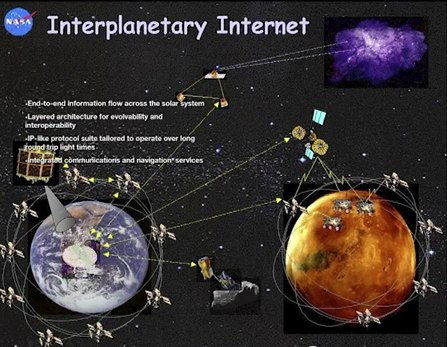
To make this work… and to make it work as seamlessly and easily as possible, it seems to me that we’re really going to want to use IPv6. Sure, it probably works fine initially with IPv4 with the limited number of devices… but as the number of devices increases, who really wants to be fooling around with subnetting or NAT with devices scattered all over the solar system? Far better, I would think, to use an addressing scheme that from the beginning can scale to this level as we continue to add more and more devices into space.
Now, to be clear, I have personally not been involved in any of the “Interplanetary Internet” discussions that have been going on for the last decade or so… but as I listened to that talk, all I could think of was extending the “Internet of Things” idea we use for terrestrial sensor networks out into space on a massive scale. And to me, that means IPv6.
What do you think? Will we need to use IPv6 as we expand out into space?
P.S. And for those interested in learning more about (or contributing to) work around building an interplanetary Internet, here are a couple of links to learn more: