

Spectrum is one of the most essential—yet least visible—parts of the Internet ecosystem. It’s the foundation that enables billions of people and devices to connect wirelessly, across vast distances and diverse environments.
As connectivity becomes ever more central to participation in society, understanding what spectrum is and why it matters is key to ensuring an open, globally connected, and secure Internet for everyone. Because if not managed wisely, it can deepen inequalities like the digital divide.
What Is Spectrum?
When we say “spectrum,” we usually refer to the range of radio frequencies that carry wireless signals. In a basic sense, it’s vibrations in electromagnetic radiation. You can understand it by looking at vibrations in other mediums: when we speak, we make sound vibrations that carry meaning to someone else who hears us. If we drop a stone into a lake, we see the waves it makes on the water. These waves can mean something if we can control how they are made.
That’s how we can communicate wirelessly: using electronic equipment to amplify and direct electromagnetic vibrations to carry information to another piece of equipment (like your phone). The distance between the peaks of the radio waves we generate is called a frequency, and ranges of frequencies are called bands (remember your Internet connectivity’s bandwidth?). These frequencies or bands encompass a wide range of electromagnetic radiation, as shown in the graphic below.
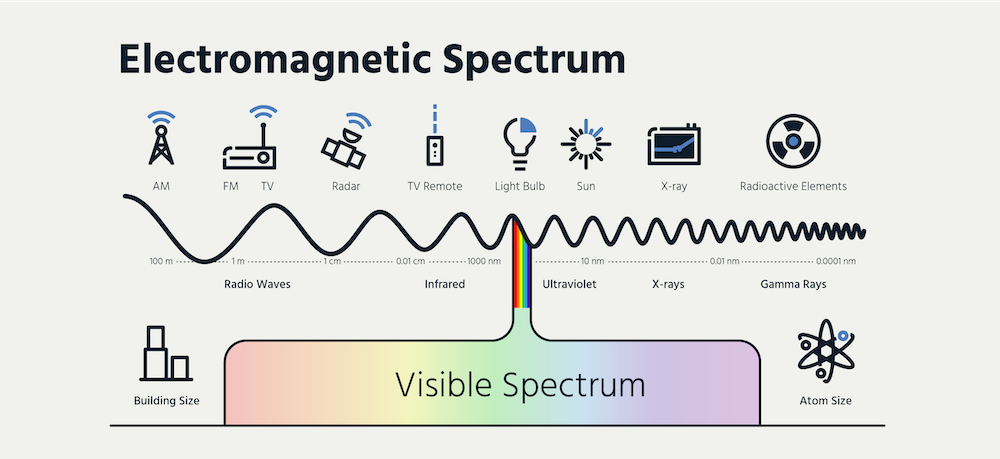
Here, we will focus on the bands used for communication. It includes everything from Wi-Fi and Bluetooth to mobile networks, satellite links, broadcast radio, and emergency services.
How Spectrum Connects Us Wirelessly
Wireless communication is possible because devices can encode information into radio waves and send these signals through the air. Each signal uses a particular frequency—a “channel”—that other devices can recognize and decode. This is like when we speak: we generate sound waves that carry meaning. The sound waves then reach another person’s ears and are decoded by their brains.
Different parts of the spectrum behave differently. Longer waves can travel through larger objects, but carry less information. Shorter waves carry more information but can’t cross barriers as easily, like walls, trees, or hills. In summary:
- Lower frequencies travel farther and penetrate obstacles more easily, making them ideal for wide-area coverage.
- Mid-band frequencies offer a balance between range and capacity, supporting both coverage and throughput.
- Higher frequencies can move large amounts of data very quickly, but only across shorter distances.
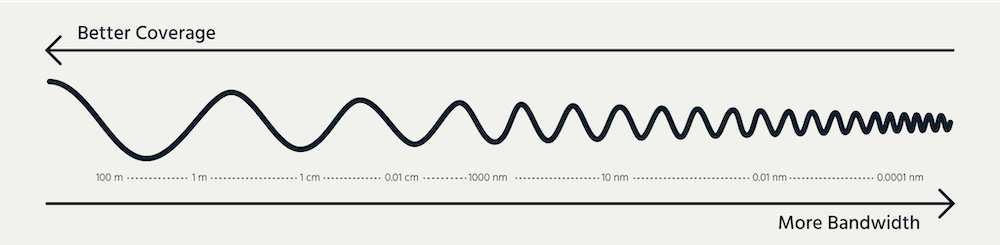
A wireless network blends these characteristics to deliver reliable, high-quality connectivity. It is this interplay of physics, engineering, and smart management that allows a single device to connect to the world in milliseconds. Every time youuse GPS or connect to Wi-Fi, you are using spectrum.
But just like a lot of people talking at the same time in a crowded room makes sound waves difficult to decipher, when a lot of waves in close frequencies are traveling through the same space, it can make them hard to receive and interpret correctly. This is called radio interference.
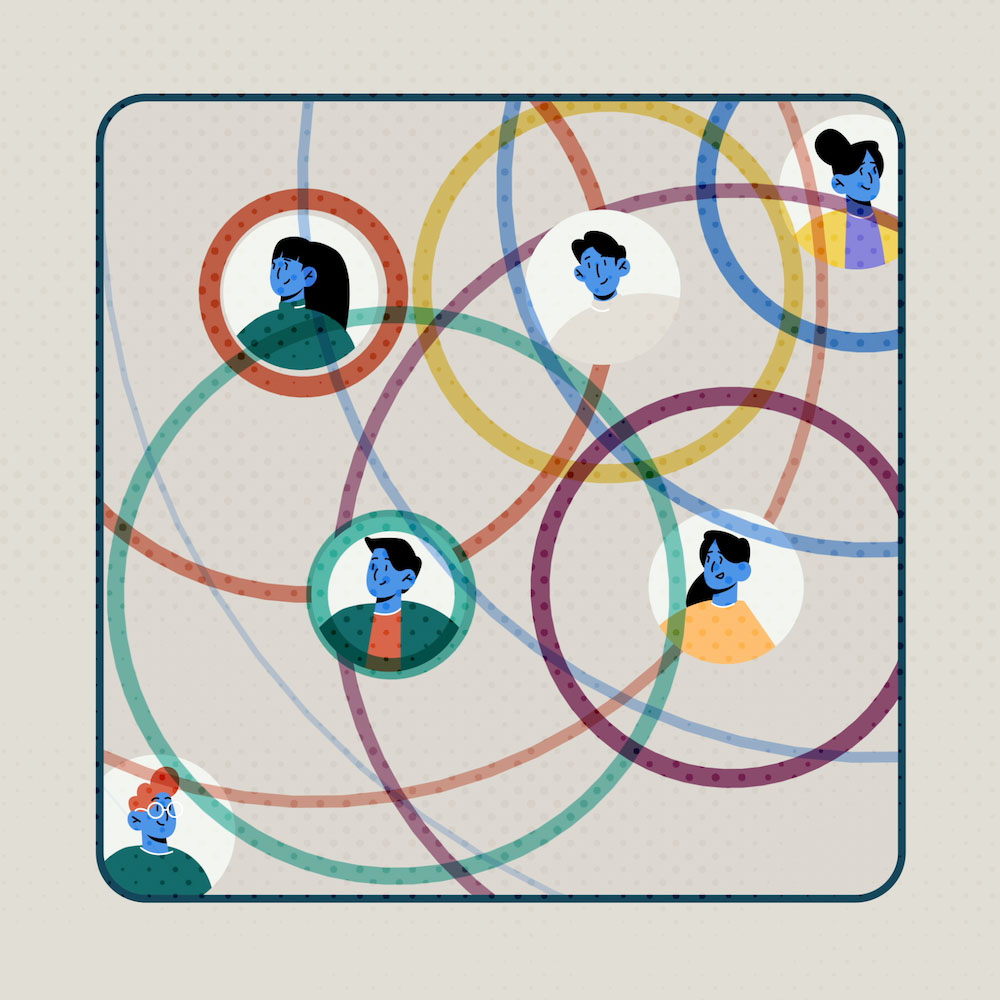
That’s why most countries have agencies known as communication regulators, whose responsibility it is to manage this to prevent radio interference from disrupting communication. These regulators make some of the spectrum bands licensed—reserved for the exclusive use of specific operators who invest in building and maintaining network infrastructure. Others are unlicensed, open to anyone following basic technical rules. These unlicensed bands have enabled Wi-Fi and countless other communications. Wi-Fi, in turn, has enabled communities around the world to manage their own community connectivity.
Why Spectrum Policies Matter
Spectrum is a shared, finite public resource. How governments and regulators manage it has profound implications for connectivity, innovation, and digital inclusion. There’s a common misconception that spectrum is now in short supply, but this isn’t true. There’s more than enough room for everyone to use it. But it requires innovation in the management of spectrum, particularly how spectrum is shared, to create the conditions for affordable access for all.
A recent example of how thoughtful spectrum policy can advance digital inclusion comes from Canada. In January 2026, the Government of Canada announced its first-ever Indigenous priority window for unused spectrum, set to begin in June 2026. This policy creates a one-year opportunity for Indigenous communities to apply first for licences in available bands before they are opened to general access—recognizing that spectrum sitting unused under nationwide licences can, instead, be a powerful enabler of community-centered connectivity.
This shows us that it’s possible to create frameworks that allow both large and small players to share spectrum, so more communities have access to meaningful, quality connectivity. Here are some ways to use policy changes to unlock unused or underused spectrum, and open opportunities along with it:
Allocate More Spectrum to Wi-Fi
Wi-Fi is usually the most affordable way to set up a small network, especially in an unconnected community. This part of the spectrum can be used to create a community mesh network based on standard home routers and repeaters, bringing low-cost, quality Internet to even remote areas.
Wi-Fi is a license-exempt use of spectrum, so when you allocate spectrum for it, you also ease some burden of licensing, which can otherwise be a huge barrier to success.
Implement Use-It-or-Share-It Rules
This is one of the most challenging to achieve, but it’s also the best way to make your spectrum ready to meet the connectivity and traffic demands of the future. A great example is what’s called citizen broadband radio spectrum (CBRS)in the United States. It combines the principles of exclusive spectrum licensing in areas where there is demand for spectrum with license-exempt use in areas where spectrum remains unused.
Large operators tend to build infrastructure in more densely populated regions where they can earn the biggest return on their investment, often leaving rural areas unserved. Use-it-or-share-it rules can make the spectrum that the large operators choose not to use available to alternative service providers
Local Licensing
In many countries, spectrum policies are still based on one or two large incumbent telecommunications companies, who might have nationwide allocation, even in areas that don’t make financial sense for them to serve.
Today, there’s so much potential for diversity in the market that this blanket can result in unconnected areas that actually have available spectrum, it’s just not being used. Regulators can create policies that require providers to use their allocated spectrum or yield it to a potential user who will put it to use.