Growing the Internet > Internet Exchange Points (IXPs)
Internet Exchange Points (IXPs)
IXPs make the Internet faster and more affordable.
Feet pounding, the runner broke into a sprint, pulling away from the pack. This wasn’t just any race. In Vienna, Eliud Kipchoge made history when he became the first person to run a marathon in under two hours. And his people were able to see it in realtime – thanks to Internet exchange points (IXPs).
Millions of hopeful, then jubilant, Kenyans watched as he broke that world record. It was made possible by Internet traffic flowing quickly and efficiently, and, most importantly, locally.
Streaming that run to Kenya, digital home schooling, and the global work-from-home economy depend on IXPs.
They’re Internet intersections, where networks connect locally to exchange traffic. It seems simple, that information would flow in the most direct route, but many times there is no direct route at all. Messages, videos, and other Internet information can sometimes travel thousands of miles around different countries and even continents to get to a destination a mere town away.
What is an IXP?
It’s a physical and usually neutral location where different networks meet to exchange local traffic via a switch. There are generally five different types of IXP developers: nonprofit organizations, associations of ISPs, operator-neutral for-profit companies, university or government agencies, and informal associations of networks.
IXPs create shorter routes for Internet traffic. It’s a more affordable alternative to sending local Internet traffic abroad. They offer better resilience, stability, efficiency, and quality improvements all at a lower cost.
The Internet Society works to expand IXPs around the world. For an IXP to work it needs switches, routers, servers, a neutral location, appropriate power sources, cooling, security, and a technical community of experts to run and manage the IXP. We work with communities to improve local Internet infrastructure by providing equipment, technical trainings, and strengthening trust and cooperation between the people who build the Internet.
Impact of COVID-19 on the Internet Ecosystem in Bangladesh, Bhutan, and Pakistan
COVID-19 has highlighted the importance of robust and resilient Internet infrastructure for every economy. As more work, entertainment and communications move online, it impacts Internet performance. This report examines what happens when the Internet infrastructure is weak. Conducted in Southwest Asian countries, it is full of suggestions on how to improve Internet infrastructure.
Moving Toward an Interconnected Africa: The 80/20 Initiative
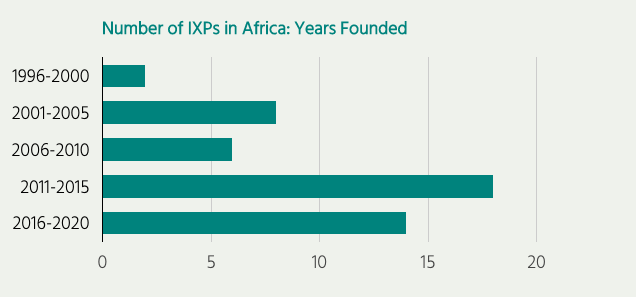
In 2010, in collaboration with the African Peering and Interconnection Community, we set up the ambitious goal that 80% of African Internet traffic be accessed in Africa in 2020. This report assesses the progress and impact that the collaboration have had in establishing peering, interconnection and IXPs as focal points for localizing traffic, and to bring faster and more affordable Internet to people.
The report expands on a 2020 analysis of IXP growth in Kenya and Nigeria and provides an overview of the evolution of Internet interconnection on the continent by examining a country in each of the six subregions: Angola (Southern Africa), Burkina Faso (Western Africa), Democratic Republic of Congo (Central Africa), Egypt (Northern Africa), Mauritius (Indian Ocean), and Rwanda (Eastern Africa).
Help Grow the Internet!
Building a successful IXP isn’t just an engineering job. It takes time and effort to develop trust, common understanding, and mutual agreements in local communities. We’d love you to join us.
Resources
Policy Brief: Interconnection and Regulated Traffic Obligations
Community-Driven IXPs
2024 East Africa Submarine Cable Outage Report
2024 West Africa Submarine Cable Outage Report
Impact of COVID-19 on the Internet Ecosystem in Bangladesh, Bhutan, and Pakistan
News
How Local Peering Is Strengthening Africa’s Internet
The World Cup of Internet Resilience
Zombie IXPs: The Four Types of Exchanges That Refuse to Die, but Fail to Live
The Shift in Peering Threatening the Internet’s Foundations
Local Infrastructure, Lower Costs: How Peering Is Moving the Needle on Internet Affordability
Moving the Needle on Universal and Meaningful Access
Image credit: © Internet Society / Nyani Quarmyne / Panos Pictures