
All things come to those who wait, and bufferbloat measurement tools are no exception. When we hosted a workshop on reducing Internet latency way back in 2013, one of the identified outcomes was the need for better tools to help users understand when they had a bufferbloat problem, and now we have just such a tool from the awesome folks over at DSLReports.
Before going any further I should probably clarify what we mean by bufferbloat. Rather than going into the details of bufferbloat, what it is and what causes it, it may be simpler to think about the observable result of bufferbloat: increased latency under load. This is a measure of the additional time it takes to send data over the Internet when your link to the Internet is loaded with traffic. Today we have technology that can help to reduce that additional latency to zero, or very close to that, but it is not widely deployed. To help stimulate deployment, end-users and network engineers alike have needed a tool that quickly and simply illustrates the existence of a bufferbloat problem on any given link. Enter DSLReports new speedtest.
Go to: http://www.dslreports.com/speedtest and click the button for your Internet connection type, e.g. “DSL” for ADSL lines. While the speedtest is running, you’ll see a gauge on the left-hand side of the display illustrating ‘Buffer Bloat’ – you want that to stay green for most or all of the download and upload tests.
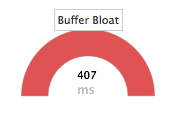
After you run the test, click the green “Results + Share” button to see more detailed information. For the moment, you need to be logged in to see the more detailed latency results. There’s a “register” link on each page.
The first time I ran the new tool it showed me that, although I had installed a new router on my connection recently that I knew included the latest technology to minimise latency under load, it wasn’t configured correctly.
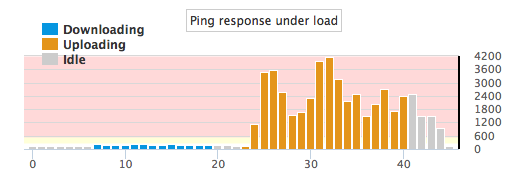
Pushing 4 seconds of additional latency under load while uploading indicates a problem.
Armed with that knowledge I tweaked the router configuration (by shaping upstream and downstream bandwidth to be just below the connection bandwidth, thereby enabling the queue management technology in the router to have an effect) and now have a much better looking set of test results.
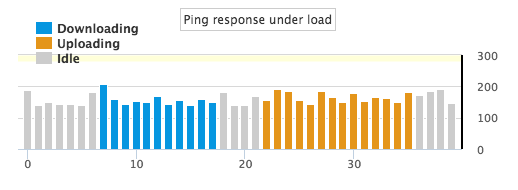
Almost no variation in latency between unloaded and loaded during both download and upload tests – this is what we want.
Minimising latency under load means that I should be better able to simultaneously use my connection for downloading large files and conducting realtime interactive communications via voice and video. Why not test your link today and share your results with colleagues and friends to raise awareness of bufferbloat as an issue and to help improve our collective Internet performance experience?
For more information about bufferbloat, how to test for it and what you can do about it, see the great resources over at bufferbloat.net.
UPDATE: In response to a few questions people have raised:
- All connection types are now enabled with bloat testing except 3G and GPRS.
- If you don’t like the results you’re getting and want to know what to do about it, see Quick_Test_for_Bufferbloat and links from there.
- If you have hardware supported by the Openwrt project then you can install Openwrt and follow instructions on configuration here: What_to_do_about_Bufferbloat
- If you don’t have Openwrt-supported hardware it’s going to be more complicated and you may be out of luck until you have different hardware.